CAP Theorem — Part 1: Foundations & Theoretical Foundations
What is this?
Picture two people on a phone call, planning where to meet for dinner. Mid-sentence, the call drops. Now each of them is stuck with the same awful choice. Option one: wait — don't go anywhere until you can reconnect and confirm the plan together, so you never end up at different restaurants. Option two: act — pick a place and go, accepting that you might guess wrong and the other person shows up somewhere else.
You cannot do both. You can't be certain you agree and also keep moving while the line is dead. That's not a phone problem — it's a logic problem, and it's the entire heart of the CAP theorem. Replace "two people" with "two servers," "the call dropped" with "the network split," and "agree on dinner" with "agree on your bank balance," and you have the single most important constraint in distributed systems.
The one-line idea: when the network between your servers breaks (a partition), you must choose: keep every server answering requests (Availability) or keep every server's data identical and correct (Consistency). During the break, you cannot guarantee both.
The dropped call gives us a vocabulary we'll reuse across all four parts. The dropped line is the partition. "Refuse to move until we reconnect" is a CP system. "Pick a place and go" is an AP system. Let's earn every piece of that.
1. Where CAP came from, and why it's a theorem
Eric Brewer proposed CAP as a conjecture in 2000; Seth Gilbert and Nancy Lynch turned it into a proven theorem in 2002. That word matters. CAP is not advice or a rule of thumb you can engineer your way around — it's a mathematical impossibility result, like "you can't have a triangle with four sides." No amount of clever code makes it go away.
Here's the cleanest way to see why. Take the simplest possible distributed system: two nodes, both holding the value x = 0. Now the network between them dies, and a client writes x = 1 to node A.
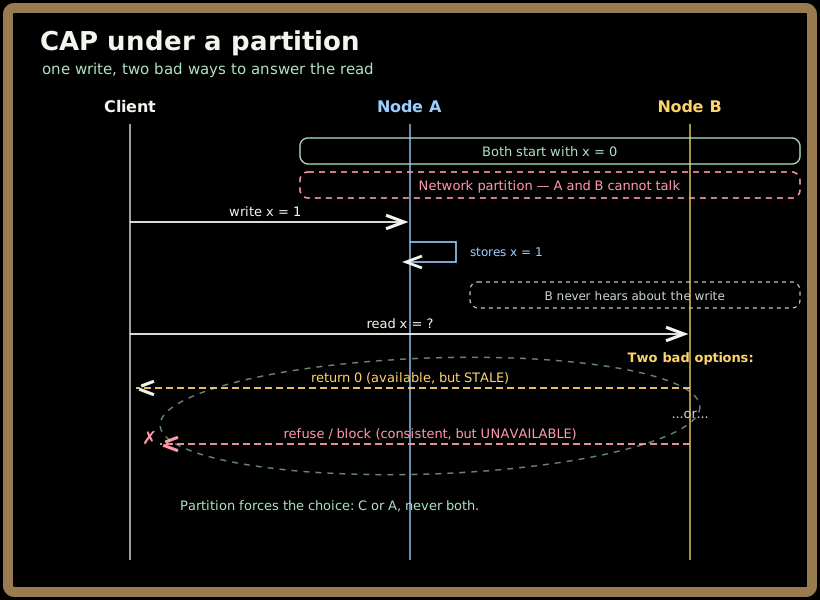
Node B is now cornered, exactly like the person whose call dropped. A client asks B for x. B can either answer 0 — which is fast and available but wrong, because the real latest value is 1 over on A — or B can refuse to answer until it can reach A and sync up — which is correct but unavailable. There is no third door. That's the whole proof in one picture: under a partition, a node must sacrifice consistency or availability.
💡 The deep reason B is stuck: it cannot tell the difference between "A is slow" and "A is dead." A silent network looks identical to a crashed peer. This ambiguity is formalized in the FLP impossibility result (Fischer, Lynch, Paterson, 1985), which proves that consensus is impossible in an asynchronous network if even one process can fail. CAP is FLP's practical cousin.
2. The three letters, said precisely
CAP gets mangled constantly because people use the three words loosely. Here are the definitions distributed-systems researchers actually mean — and they're stricter than the everyday English versions.
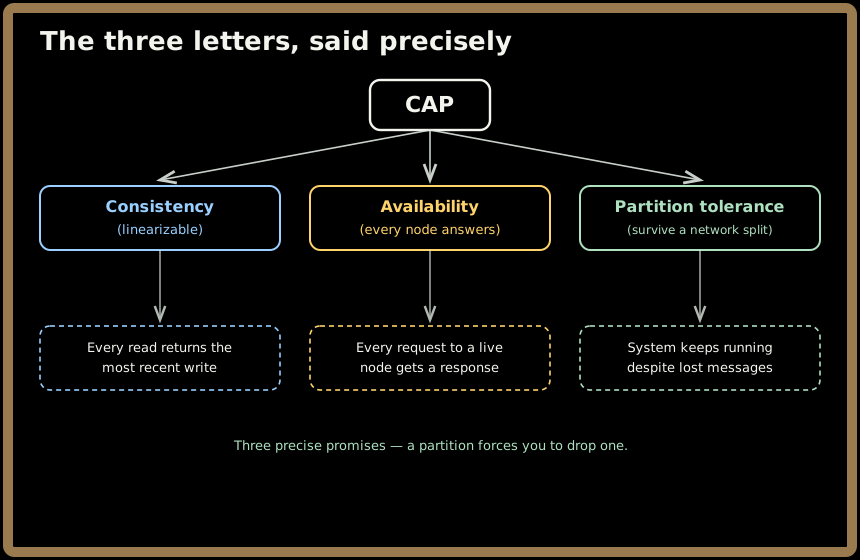
- Consistency (C) here means linearizability — the strongest form. Every read returns the result of the most recent completed write, and the whole system behaves as if there were exactly one copy of the data updated atomically. Note this is not the "C" in ACID (which is about transaction invariants). Same letter, different idea — a classic interview trap.
- Availability (A) means every request to a non-failing node receives a (non-error) response — eventually, without hanging forever. Crucially, an available system is not allowed to reply "sorry, try later." That refusal counts as unavailable.
- Partition tolerance (P) means the system keeps functioning even when the network drops or delays messages between nodes arbitrarily.
The strictness of these definitions is what makes the theorem bite. If you let "consistency" mean "pretty fresh" and "availability" mean "usually up," the trade-off blurs. With the precise definitions, the impossibility is sharp.
3. "Pick two of three" is a lie. Here's the truth.
You've probably seen CAP drawn as a triangle where you choose two corners and drop one. That framing is wrong, and saying so in an interview is an instant signal of real understanding.
Here's why it's wrong: partition tolerance is not optional. Networks fail. Cables get cut, switches reboot, a cloud availability zone loses connectivity, a garbage-collection pause makes a node look dead for 8 seconds. If your system spans more than one machine, partitions will happen — they're not an edge case you can design out, any more than you can design out the possibility of a phone call dropping.
So you don't get to "drop P." You're keeping P no matter what. The real choice only appears the moment a partition strikes, and it's binary:
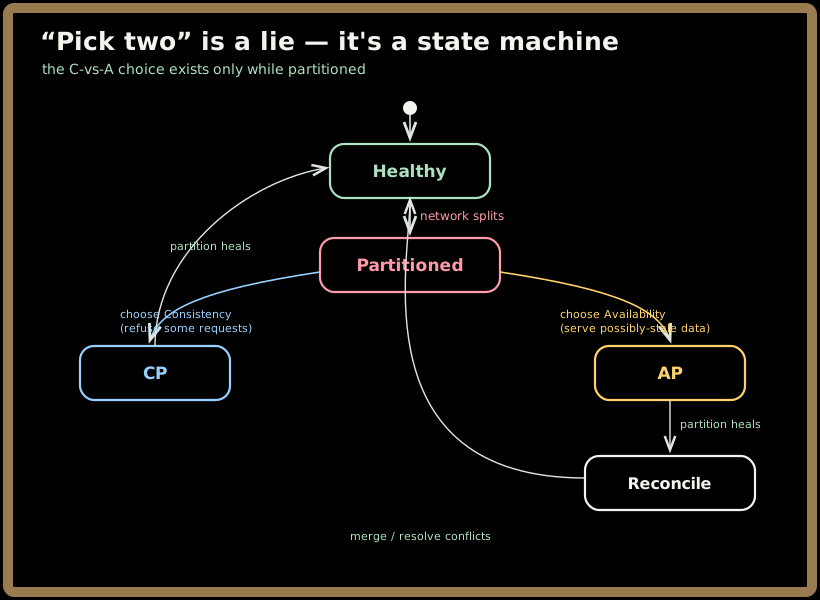
- A CP system, when partitioned, sacrifices availability to stay correct. The minority side stops answering. (Our dinner-planner who refuses to leave the house.)
- An AP system, when partitioned, sacrifices consistency to stay up. Every node keeps answering, possibly with stale data, and sorts out the mess later. (The dinner-planner who picks a restaurant and goes.)
⚠️ The most important nuance: the trade-off only applies during a partition. When the network is healthy — which is almost all the time — a well-built system can be both strongly consistent and highly available. CAP describes a failure mode, not a permanent tax. We'll see in Section 6 why that "almost all the time" caveat opens the door to PACELC.
Quick check before moving on:
4. What a CP system actually does under partition
Let's make CP concrete. The defining move of a CP system is the quorum: to commit a write or serve a guaranteed-fresh read, you need a majority of nodes to agree. With 5 nodes, a quorum is 3.
Now a partition splits the cluster into a group of 3 and a group of 2:
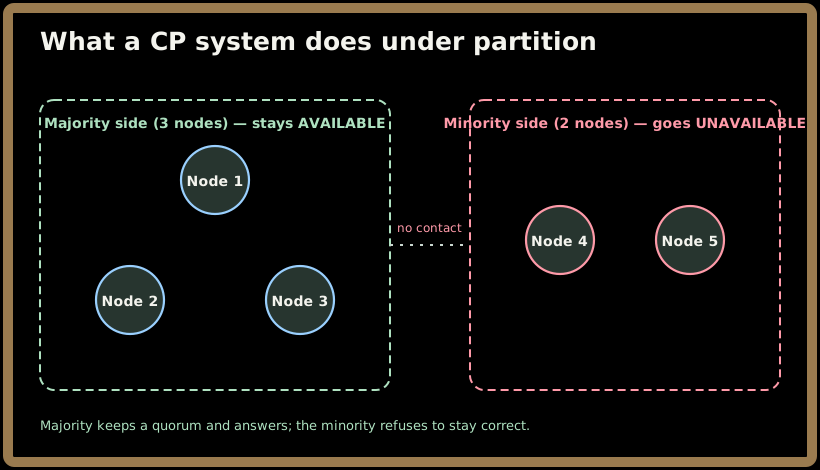
The majority side (3 nodes) can still form a quorum, so it keeps accepting reads and writes. The minority side (2 nodes) cannot reach a majority, so it refuses to serve — it returns errors rather than risk handing out stale data or accepting a write the rest of the cluster won't see. That refusal is the price of correctness, and it's exactly how etcd, ZooKeeper, and a Raft-based store behave (we'll dissect these in Part 3).
The quorum rule is also what prevents the nightmare scenario called split-brain: two sides of a partition both believing they're in charge and both accepting conflicting writes. By requiring a majority, at most one side can ever be active — and two majorities can't exist at once. That single guarantee is why CP systems use odd node counts (3, 5, 7): so there's always a clear majority.
5. What an AP system actually does under partition
The AP philosophy flips the priority: never tell a user no. When the same partition hits, both sides keep serving. Each accepts writes locally and trusts that things will get reconciled once the network heals.
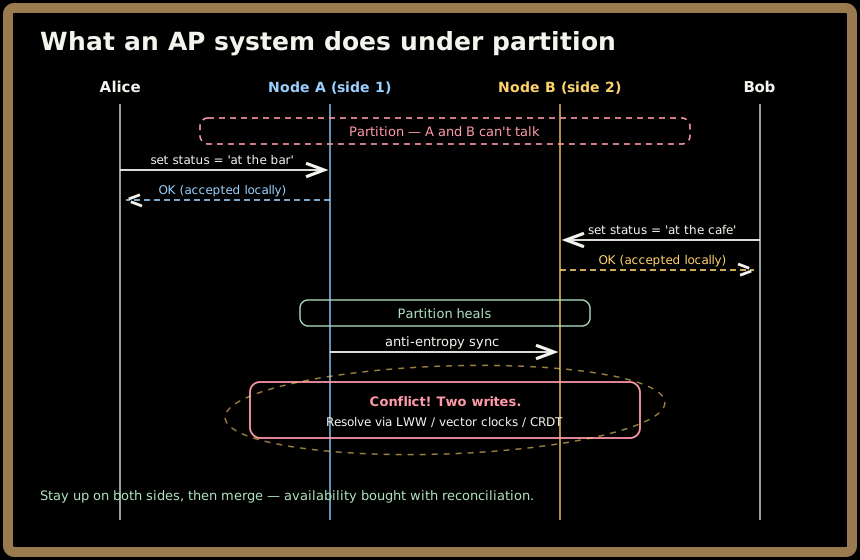
This buys maximum availability and low latency, but it creates a new job: reconciliation. When the partition heals, both sides may have accepted writes to the same key, and now they conflict. The system needs a strategy to merge them — last-write-wins by timestamp (simple but can lose data), vector clocks (track causality), or CRDTs (conflict-free replicated data types, which are mathematically designed to always merge cleanly). Cassandra and DynamoDB live here; we'll cover the reconciliation machinery in depth in Part 2.
💡 The honest framing for an interview: CP trades availability for correctness; AP trades correctness for availability. Neither is "better." A bank ledger should be CP (a wrong balance is a disaster). A "who's online" indicator should be AP (a slightly stale green dot harms no one). The skill is matching the choice to the data, not to a tribe.
Quick check before moving on:
6. CAP is too simple: meet PACELC
CAP has a real blind spot: it only says anything about the partitioned state. But partitions are rare — your network is healthy 99.9%+ of the time. CAP is silent on how your system should behave during all those normal hours. That silence is what PACELC fills in.
PACELC (Abadi, 2012) reads as: if Partition, then Availability vs Consistency; Else, Latency vs Consistency.
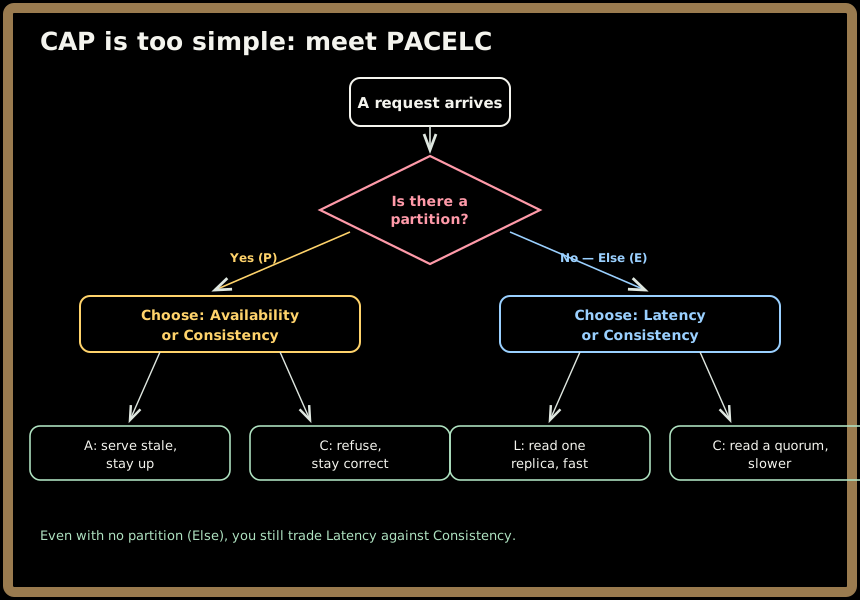
The "Else" half is the insight CAP misses. Even with a perfectly healthy network, strong consistency still costs you — to guarantee a read is fresh, you have to contact a quorum of replicas (maybe across regions), and waiting for those round-trips adds latency. So every system faces a second trade-off, all day every day, between latency and consistency, completely independent of partitions.
This is why systems get classified with two letters. DynamoDB is PA/EL — gives up consistency for availability under partition, and gives up consistency for low latency normally. Spanner is PC/EC — chooses consistency in both cases, paying with availability under partition and latency the rest of the time. PACELC captures the full personality of a system; CAP only captures its behavior during a storm.
7. Three misconceptions worth unlearning
Because CAP is so often taught badly, a few wrong ideas calcify. Clear them out now.
- "CAP is a design dial you turn." No. CAP behavior is emergent from your architecture — your replication protocol, your quorum settings, your failure handling. You don't flip a "CP switch"; you build a system whose behavior under partition is CP. The choice is real, but it's expressed in design, not configuration alone.
- "A system is globally CP or globally AP." Rarely true. Real systems mix: a shopping site might run CP for the payment ledger and AP for the product-review counts in the very same request. CAP applies per operation and per data type, not to a whole company's stack.
- "Consistency and availability are always at war." Only during a partition. The rest of the time you can have both — which is exactly why PACELC exists and why "highly available, strongly consistent" databases are a real, sold product (when the network cooperates).
Quick check before moving on:
Key takeaways
- CAP is a proven impossibility theorem, not a design choice: when the network partitions, you cannot keep every node both consistent (correct, identical data) and available (always answering).
- "Pick two of three" is wrong. Partition tolerance is mandatory because networks fail; the real choice is CP vs AP, and it appears only during a partition.
- CP systems sacrifice availability to stay correct — the minority side of a partition stops answering (quorums, majority rule, no split-brain). AP systems sacrifice consistency to stay up — every node keeps serving and reconciles conflicts later.
- Match the choice to the data: CP for money and coordination, AP for feeds, presence, and counters. Most real systems mix both per operation.
- PACELC completes the picture: Else of a partition, you still trade Latency vs Consistency — which is why strong consistency costs you even when the network is perfectly healthy.
One more drill before you go:
Part 2 zooms into the word we've been treating as binary — consistency — and reveals the rich spectrum between "perfectly correct" and "eventually correct," and how each level is actually built.