Ratio Hiring
What is this?
You are hiring a crew, and two rules bind at once: everyone is paid in proportion to how much work they do, and nobody accepts less than their stated minimum. Together these force a single pay rate for the whole crew — the rate demanded by the greediest member relative to their output.
That is two variables interacting, which is exactly what makes the naive approach hopeless and the sorted approach easy.
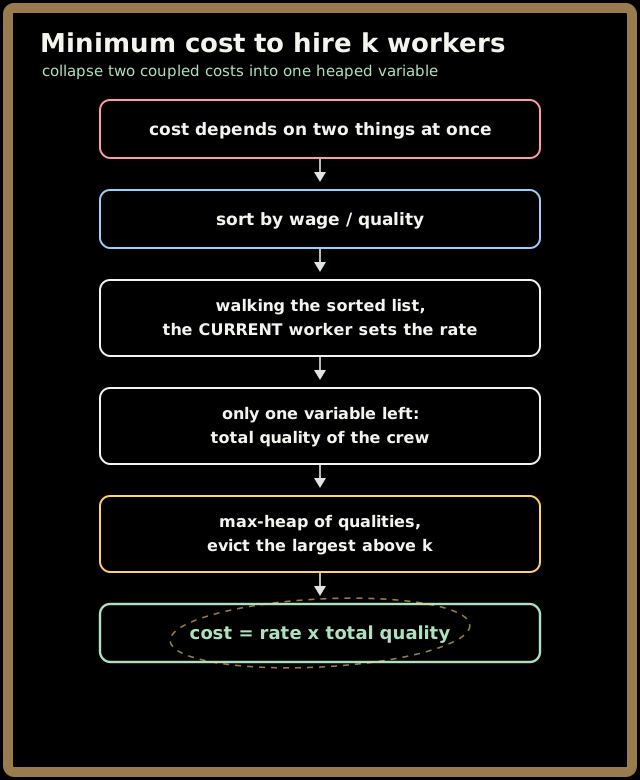
💡 Fun fact: the reason sorting by ratio works is worth stating precisely. If you hire a group, the shared rate must satisfy every member, so it equals the maximum wage-to-quality ratio in the group. Walking the list in ascending ratio order means the worker you have just reached has the highest ratio of anyone so far — so that worker is the rate for any crew drawn from the prefix. The two-variable optimisation collapses into "minimise total quality", which a heap does trivially. It is the same manoeuvre as 201's Maximum Performance of a Team, where sorting by efficiency fixes the multiplier.
🔓 The 2 problems in this chapter are free. Sign in with Google or Microsoft to start solving.
The one-line idea: sort by the ratio so the current element fixes the rate, then use a heap to minimise the only quantity still free. Two interacting variables become one.
1. The algorithm
workers = sorted((w / q, q) for q, w in zip(quality, wage))   # ascending ratio
heap, total, best = [], 0, float('inf')
for ratio, q in workers:
    heapq.heappush(heap, -q)          # max-heap of qualities
    total += q
    if len(heap) > k:
        total += heapq.heappop(heap)  # remove the LARGEST quality (negated)
    if len(heap) == k:
        best = min(best, ratio * total)
return best
Three points to defend out loud. The heap holds qualities, not wages, because once the rate is fixed the cost is rate × total quality and nothing else matters. The heap is a max-heap — you evict the largest quality, which is the expensive one, keeping the k cheapest. And the answer is recorded only when exactly k workers are held, since a smaller crew does not satisfy the requirement.
Note total += heapq.heappop(heap) rather than -=: the popped value is already negative, so adding it subtracts the quality. That sign inversion is a routine source of bugs.
2. The bounded-pool variant
Total Cost to Hire K Workers changes the shape: candidates are taken from the front and back of a queue, with only a bounded number visible from each end. Two heaps — one per end — hold the visible candidates, and after each hire the corresponding end advances and refills its heap.
The tie-break is stated and must be respected: on equal cost the lower index wins, which means the front heap is preferred when the two tops are equal. And the pointers must never cross — once they meet, all remaining candidates are already in the heaps and no refilling should occur.
3. A 30-second worked example
quality = [10, 20, 5], wage = [70, 50, 30], k = 2.
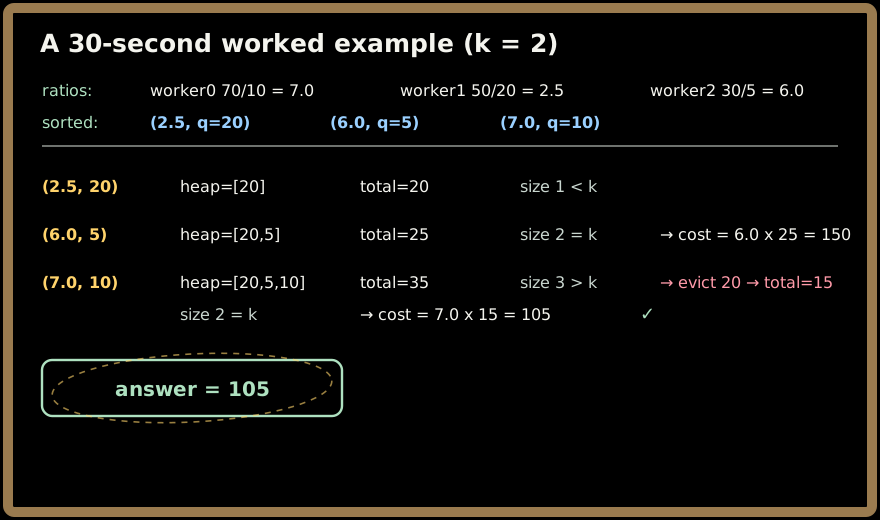
The last step is the instructive one: paying a higher rate became cheaper because evicting the high-quality worker cut the total quality by more than the rate rose. That trade is invisible without the heap.
4. Where you'll actually meet this
- Contract and gig pricing. Group rates where one member's minimum sets the floor for everyone.
- Cloud instance selection. Choosing a fleet under a shared price tier, minimising total capacity purchased.
- Freight and logistics. Load allocation where a single per-unit rate applies across the whole shipment.
- Auction and procurement systems. Uniform-price clearing, where the marginal bid sets the price for all winners.
- Hiring pipelines. The bounded-pool variant is literally how batched candidate selection from two ends of a ranked queue is implemented.
5. Problems in this chapter
▶ Minimum Cost to Hire K Workers
Hire exactly k workers paid proportionally under one shared rate. Sort by wage/quality, keep the k cheapest qualities in a max-heap, and evaluate at every step where the heap is full.
Pattern: sort to fix the rate + size-k heap. Target: O(n log n) time, O(k) space.
▶ Total Cost to Hire K Workers
Hire k workers from the two ends of a queue with a bounded visible pool. Two heaps, refilled as each end advances, with ties going to the lower index.
Pattern: dual bounded heaps with pointer refill. Target: O((k + candidates) log candidates).
6. Common pitfalls 🚫
- Heaping wages instead of qualities. Once the rate is fixed, cost is rate × total quality — wages are already accounted for by the ratio.
- Using a min-heap. You evict the most expensive quality, so the heap must expose the largest.
- Recording a cost before the heap is full, which prices a crew smaller than
k. - Sign errors on the negated pop. The popped value is negative; add it rather than subtracting.
- Floating-point ratio ties. Where precision is tight, compare
w1 * q2againstw2 * q1instead of dividing. - Crossing the pointers in the bounded-pool variant, which hires the same candidate twice.
- Getting the tie-break backwards — equal cost means the lower index, so the front heap wins.
7. Key takeaways
- Sort to fix one variable. Ascending ratio makes the current worker the rate for the whole prefix.
- Then minimise what is left — total quality — which is exactly what a size-
kheap does. - Evict the largest, so the heap must be a max-heap.
- Evaluate only at full size. A partial crew is not a candidate answer.
- A higher rate can be cheaper if it lets you drop an expensive member; the heap is what finds that.
- Cross-multiply instead of dividing when ratio ties need exactness.
- Why interviewers like it: the greedy is not obvious and the proof is short, so it separates candidates who can justify a sort order from those who try every subset.
Order: Minimum Cost to Hire K Workers → Total Cost to Hire K Workers.