Path Navigation
What is this?
A file path like /home/user/../photos is really a set of walking directions through folders, and .. just means "step back out of the folder I just entered." Since stepping back always undoes your most recent step, a stack handles it perfectly — like a pile of folders you can only add to or remove from the top. Replay the directions on a stack and whatever folders remain are the clean, simplified path.
💡 Fun fact: Your operating system simplifies paths this exact way every time you open a file, and it also uses the rule to stop sneaky paths full of
..from escaping into folders you should not reach.
🔓 The 1 problem in this chapter is free. Sign in with Google or Microsoft to start solving.
Core idea: A filesystem path is a script of stack operations. Each directory name is a
push, every..is apop, and.or empty segments (from//) are no-ops. Run the script and the stack you're left with is the resolved path.
Why a stack models a path
Walking into a directory and walking back out with .. is inherently LIFO: .. always cancels the most recently entered directory. That's a pop. So canonicalizing a path is just: split it into segments and replay them as pushes and pops.
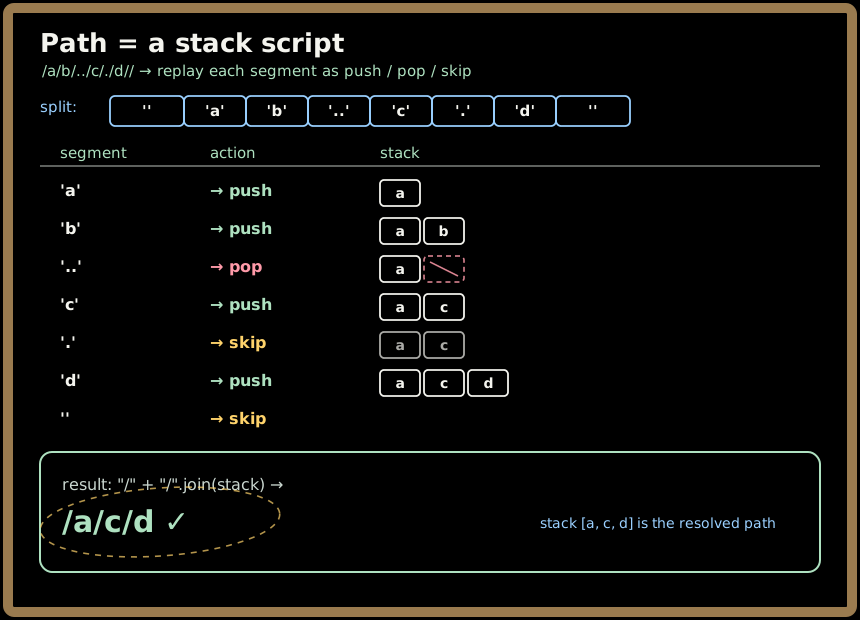
The problem in this chapter
Simplify Path — canonicalize a Unix path
Given an absolute path, produce its canonical form: starts with a single /, no trailing slash (except root), ./empty collapse away, .. goes up one level (and is a no-op at the root), and ordinary names — even odd ones like ... — stay as directories.
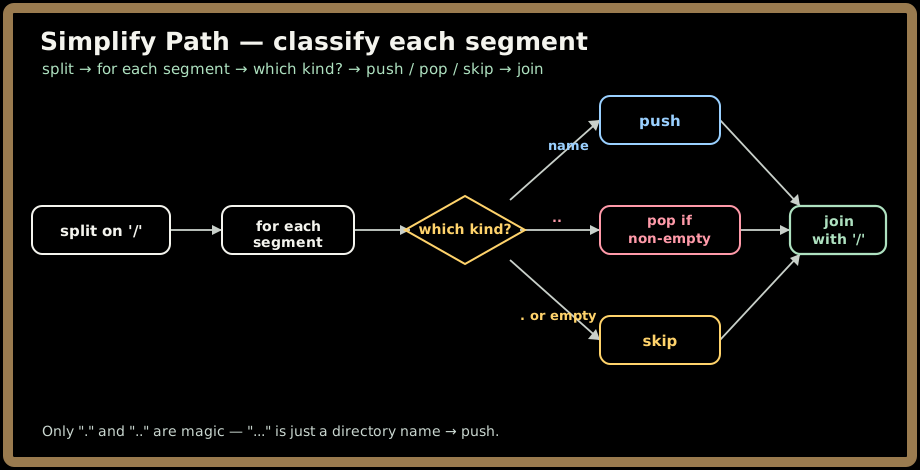
Split on /, process each token with a stack, then rebuild "/" + "/".join(stack). → O(n) time, O(n) space.
The cross-cutting skill: classify each segment
| Segment | Meaning | Stack move |
|---|---|---|
"" (from // or leading /) |
nothing | skip |
"." |
current dir | skip |
".." |
parent dir | pop (no-op if empty) |
anything else (incl. "...") |
a directory name | push |
The whole problem is a four-way classification of each token. The trap is treating
...or....as special — they're just directory names. Only exactly.and..are magic.
Where you'll meet it beyond the interview
- OS kernels resolve paths exactly this way (and must reject
..escaping a chroot — a path-traversal security check). - Container runtimes resolve overlay/bind mounts by canonicalizing paths.
- Proxies, routers, and CDNs normalize URL paths before matching routes or cache keys.
- Object stores canonicalize keys that look like paths.
📓 Draw it yourself
- Path as a stack script. Take
/x/y/../../z/and draw the directory stack evolving segment by segment. Watch..pop and the double-..-at-root do nothing. - The four cases. Make a tiny table on paper:
"",.,..,name→ skip/skip/pop/push. Internalize that...falls into "name."
Snap photos and embed them with the /host-diagrams skill.
Complexity at a glance
| Problem | Time | Space |
|---|---|---|
| Simplify Path | O(n) | O(n) |
Key takeaways
- A path is a stack script: names push,
..pops,./empty skip. ..at the root is a no-op — pop only if the stack is non-empty.- Only
.and..are special;...,....are ordinary directory names. - Rebuild as
"/" + "/".join(stack)to get the single-leading-slash, no-trailing-slash form for free. - Why this chapter matters: it's literally how kernels, containers, and proxies resolve paths — and a clean, real-world showcase of the push/pop instinct.
Problem: Simplify Path.