Expression Evaluation
What is this?
When you work out a sum like 2 + 3 * 4, you can't finish 2 + ... until you've handled 3 * 4 first — so you set the addition aside and come back to it. A stack is the perfect scratch pad for that: it holds the pieces of a calculation you can't finish yet, like a pile of sticky notes, and hands them back the moment the missing number arrives. This is exactly how calculators and programming languages add up expressions.
💡 Fun fact: Old HP calculators made you type sums "backwards" as
3 4 +instead of3 + 4. That postfix style needs no parentheses at all, and it is exactly how a stack-based machine evaluates math under the hood.
🔓 The 2 problems in this chapter are free. Sign in with Google or Microsoft to start solving.
Core idea: Evaluating an expression is a stack story. The stack holds operands waiting for an operator, or a paused sub-expression waiting for its
). Whenever you can't finish a computation yet, you push the unfinished part; when the missing piece arrives, you pop and combine.
Why a stack is the natural fit
Arithmetic has deferred work baked in: you can't apply + until you have both operands, and a ( means "set this aside, I'll come back after the matching )." A stack is precisely the structure for "set aside the most recent unfinished thing and resume it later" — which is also why a CPU-less virtual machine evaluates code with an operand stack.
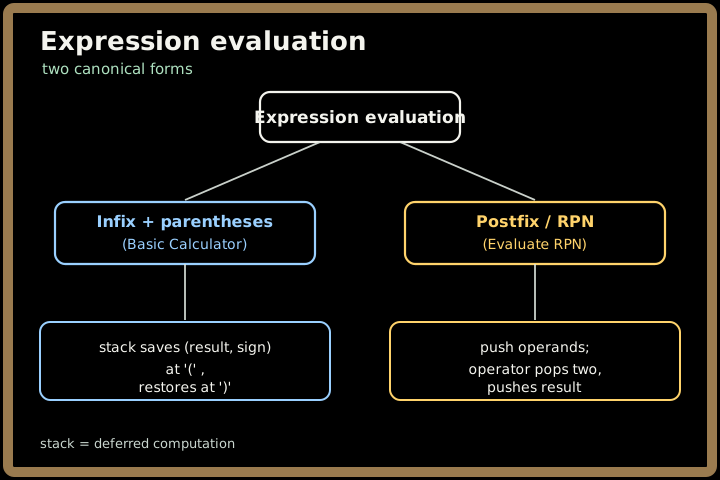
This chapter teaches the two canonical forms:
The two problems
Basic Calculator — infix with parentheses
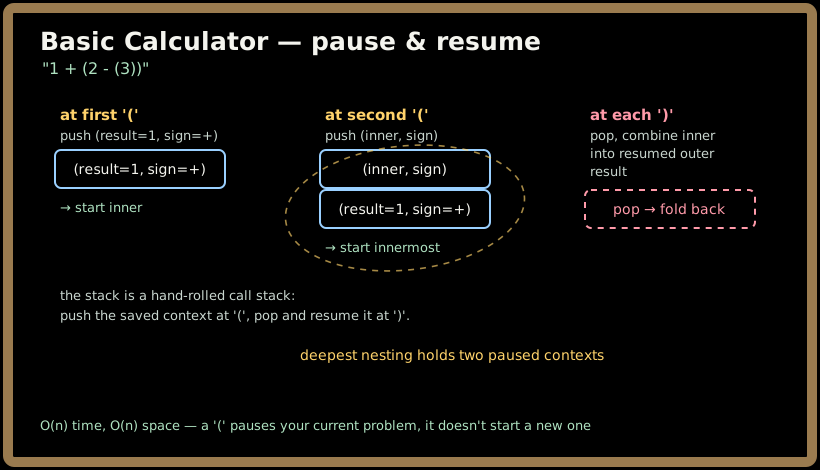
Scan left to right keeping a running result, the current_number, and the current sign. A ( pauses the current computation — push (result, sign) onto the stack and start fresh inside the parentheses. A ) finishes the inner value, then pops the saved context and folds it back in.
A
(doesn't start a new problem — it pauses your current one. The stack is a hand-rolled call stack. → O(n) time, O(n) space.
Evaluate Reverse Polish Notation — postfix, the stack machine
In postfix the operator follows its operands, so no parentheses or precedence rules are needed. Push every number; on an operator, pop the top two, apply, push the result. The last value left is the answer.
![Evaluate RPN operand stack machine processing ["4","1","+","3","*"] to 15](https://maangioassets.blob.core.windows.net/diagrams/coding-interview/101/chapters/stack/expression-evaluation/expression-evaluation-summary-diagram-3.svg)
Mind the order: the first value popped is the right operand (matters for - and /), and division truncates toward zero. This loop is a miniature bytecode interpreter. → O(n) time, O(n) space.
The cross-cutting skill: what's on the stack?
| Problem | Stack holds | Pop trigger |
|---|---|---|
| Basic Calculator | paused (result, sign) contexts |
a ) resumes the outer expression |
| Evaluate RPN | operands awaiting an operator | an operator consumes two operands |
Both are "defer until you can combine." Infix defers around parentheses; postfix defers operands until their operator shows up. Name what the stack is holding and the code follows.
Common pitfalls
- Operand order for
-and/:b = pop(); a = pop(); a - b. - Truncation toward zero for division of negatives — in Python use
int(a / b), nota // b. - Multi-digit numbers and spaces in the infix scanner — accumulate digits, skip blanks.
- Sign handling around
(and leading/unary minus in the calculator.
📓 Draw it yourself
- Pause & resume. For Basic Calculator, draw the stack each time you hit
((push the saved result+sign) and)(pop and fold back). Watch the outer computation freeze and thaw. - The RPN machine. Draw the operand stack as you scan
["5","1","2","+","*"]; circle the two operands an operator pops and the single result it pushes.
Snap photos and embed them with the /host-diagrams skill.
Complexity at a glance
| Problem | Time | Space |
|---|---|---|
| Basic Calculator | O(n) | O(n) |
| Evaluate RPN | O(n) | O(n) |
Key takeaways
- The stack holds deferred work — paused sub-expressions (infix) or pending operands (postfix).
- Parentheses = push/restore context; a
(pauses, a)resumes — a hand-built call stack. - Postfix needs no precedence or parentheses — which is exactly why VMs and calculators use it.
- Watch operand order and integer truncation — the two most common bugs here.
- Why this chapter matters: it's the foundation of compilers, interpreters, and stack machines — the clearest place where "stack = deferred computation" pays off.
Order: Basic Calculator (infix + parens) → Evaluate RPN (the stack machine).
Basic Calculator
Core idea: A
(lets you pause the calculation you were doing and save it on a stack; a)lets you resume it — so the stack is just your memory of "where was I?"
Problem, rephrased
Imagine you're building the formula engine behind a tiny spreadsheet. A user types a formula into a cell as plain text — something like 8 - (3 + 2) — and your job is to hand back a single number. The only things they're allowed to write are:
- whole, non-negative numbers (possibly with several digits, like
42), - the operators
+and-, - round brackets
(and)to group things, - and as many spaces as they feel like sprinkling around.
There is no * or / here — just addition, subtraction, and grouping. Your function gets the raw string and must return the integer it evaluates to. The numbers you type are never negative, but the result of a group certainly can be (e.g. 1 - 5).
| Input string | Returns | Why |
|---|---|---|
"42" |
42 |
a lone number |
"8 - (3 + 2)" |
3 |
the group is 5, then 8 - 5 |
"1 - (-2)" |
n/a | invalid — -2 is a typed negative, not allowed |
"(1+(4+5+2)-3)+(6+8)" |
23 |
nested groups |
"-(3+2)" |
-5 |
a leading minus applied to a whole group |
" 100 " |
100 |
spaces are noise |
(We'll treat a leading or post-( minus like -(3+2) as valid unary negation, because it falls out of the algorithm for free.)
Sign in to continue reading
The rest of this lesson is available with a free account. Signing in with Google or Microsoft is free.
Sign in to read the full lesson