List Fundamentals
What is this?
A linked list is a chain of nodes, where each node points to the next one — think of a treasure hunt where each clue leads you to the following clue. The fundamentals are the basic hands-on moves for working with that chain: flipping all the arrows to run it backwards, building a brand-new chain as you walk, and rearranging the nodes in place.
💡 Fun fact: Reversing a linked list is one of the most-asked coding interview questions of all time, yet the clean iterative solution needs only three pointer variables and a single pass through the list.
🔓 The 3 problems in this chapter are free. Sign in with Google or Microsoft to start solving.
Core idea: Everything you'll ever do to a linked list is re-pointing
nextfields, in order, without losing the rest of the chain. This chapter drills the three moves that underpin the whole topic: reverse it, build a new one as you walk, and restructure it in place.
The two habits that prevent every bug
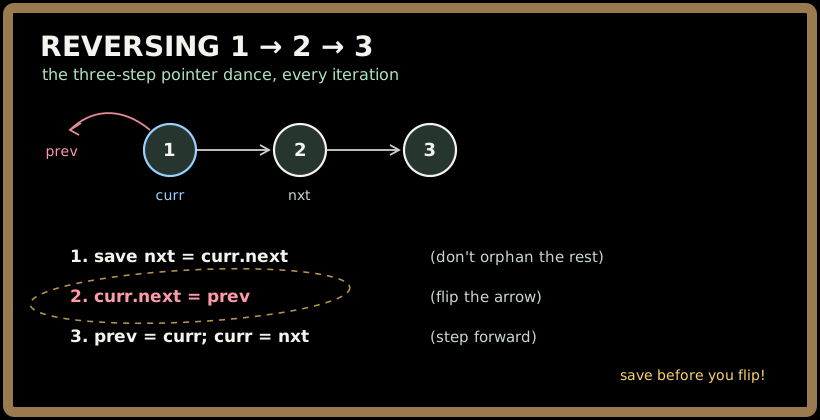
- Cache
nextbefore you overwrite it. A node has exactly one forward pointer; the instant you rewrite it, the rest of the list is gone unless you saved it. - Use a dummy head. A fake node sitting before
headmeans "edit/insert/delete at the front" stops being a special case — you always have aprevto splice from.
Master those and pointer surgery becomes mechanical.
The three problems
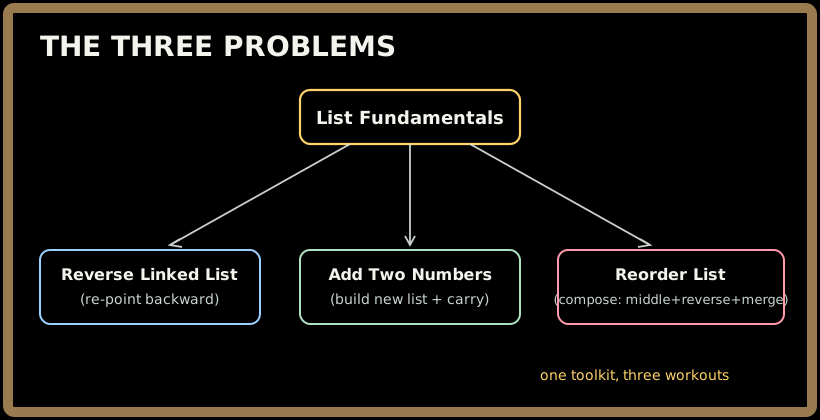
- Reverse Linked List — the keystone. Walk once, flipping each
nextto point at the previous node (cache-next first). O(n) time, O(1) space. Reorder and many later problems reuse this exact routine. - Add Two Numbers — two digit-lists (least-significant first); walk both, sum digit + carry, append to a new list built behind a dummy head. The reverse digit order is why you can add left-to-right.
- Reorder List —
L0→Ln→L1→Ln-1→…in place. Not one trick but three composed: find the middle (fast/slow), reverse the second half, merge the two halves alternately.
The moves this chapter teaches
| Move | Mechanic | Reused in |
|---|---|---|
| Cache-next reverse | save next, flip pointer, advance |
Reverse, Reorder |
| Dummy head + tail build | append to a fake-headed list | Add Two Numbers |
| Carry propagation | digit, carry = divmod(a+b+carry, 10) |
Add Two Numbers |
| Compose primitives | middle → reverse → merge | Reorder |
The progression is deliberate: Reverse teaches the atomic move, Add Two Numbers teaches building + dummy head, and Reorder shows that hard list problems are usually two or three easy ones glued together.
📓 Draw it yourself
- Reverse, arrow by arrow. Draw
1→2→3, then redraw it 3 times flipping one arrow per step withprev/curr/nextlabels. - Fold the tail onto the head. Write
1 2 3 4 5 6on a paper strip and fold it so6lands under1,5under2— that's Reorder.
Snap photos and embed them with the /host-diagrams skill.
Key takeaways
- Pointer surgery, two rules: cache
nextbefore rewiring; use a dummy head for front edits. - Reverse Linked List is the keystone — internalize it; it recurs everywhere.
- Build with a dummy head + carry for "construct a new list" problems (Add Two Numbers).
- Hard list problems decompose — Reorder = find-middle + reverse + merge.
- Why it matters: these are the precision drills every harder list (and many tree/stream) problems are built from.
Order: Reverse Linked List → Add Two Numbers → Reorder List.
Reorder List
Core idea: The reorder is just the front half interleaved with the reversed back half — so split the list at the middle, reverse the second half, and zip the two halves together node by node.
Problem, rephrased
Imagine you're seating guests around a long dinner table from a single waiting line. The line is in order of arrival: guest 0 arrived first, guest n arrived last. You want to seat them so each early-arriving guest is paired with a late-arriving one — first with last, second with second-to-last, and so on — alternating down the line until they meet in the middle. The earliest guest still leads, the latest guest comes next, then the second-earliest, then the second-latest.
Concretely: you're given a singly linked list L0 → L1 → … → Ln-1 → Ln. Rearrange the nodes (not their values) into the order L0 → Ln → L1 → Ln-1 → L2 → Ln-2 → …. Do it in place, using O(1) extra space, and re-link nodes rather than copying or swapping their values.
| Input list | Output list | Why |
|---|---|---|
1 → 2 → 3 → 4 |
1 → 4 → 2 → 3 |
First with last, then the inner pair |
1 → 2 → 3 → 4 → 5 |
1 → 5 → 2 → 4 → 3 |
Odd length: the middle node 3 lands last, alone |
1 → 2 |
1 → 2 |
Two nodes are already in reorder form |
7 |
7 |
A single node has nothing to interleave |
Sign in to continue reading
The rest of this lesson is available with a free account. Signing in with Google or Microsoft is free.
Sign in to read the full lesson