What to Store in the Map
What is this?
The hash table itself never changes — it is always the same instant-lookup box. What makes a problem click is choosing the right "ticket" to store. As you walk through the data, you ask what fact about the past you need to look up instantly, and you store exactly that. Pick the clever key and a slow, compare-everything-to-everything approach shrinks to a single pass.
💡 Fun fact: The "store running totals and look up the difference" idea behind Subarray Sum has a deep cousin in math called prefix sums, used as far back as 19th-century actuarial tables to total columns of figures quickly. The same move turns a question about any range into a single subtraction.
🔓 The 3 problems in this chapter are free. Sign in with Google or Microsoft to start solving.
Core idea: Every problem here uses the same hash map — what changes is the clever choice of key and value. Store the right thing and an O(n²) scan becomes a single O(n) pass. The art is asking: "as I walk the data, what fact about the past do I need in O(1) — and what key unlocks it?"
The move
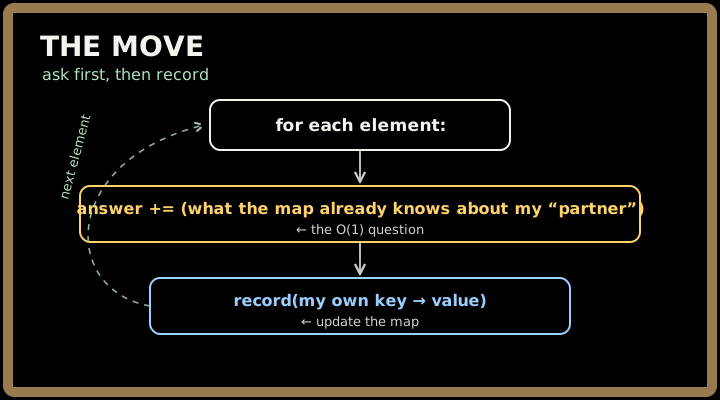
The trick is defining "partner" and the key:
- Two Sum → partner =
target - x; store value → index. - Subarray Sum Equals K → partner = a previous prefix sum
s - k; store prefix-sum → count (seed{0:1}). - Pairs of Songs Divisible by 60 → partner =
(60 - r) % 60; store remainder → count.
The three problems
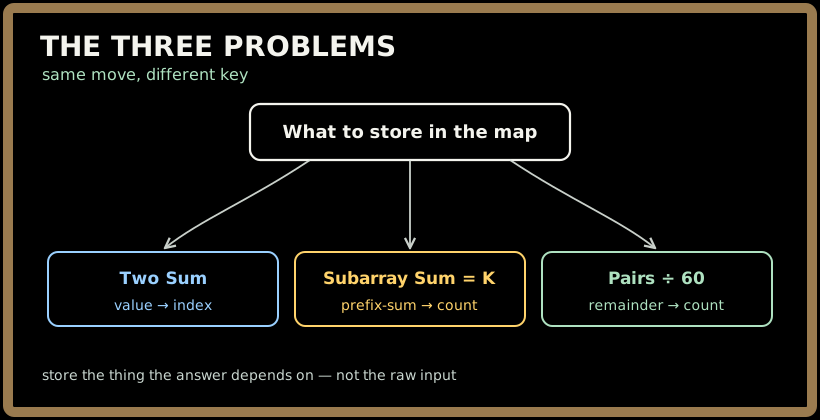
| Problem | Key → value | Partner you look up |
|---|---|---|
| Two Sum | value → index | target - x |
| Subarray Sum Equals K | prefix-sum → frequency | running_sum - k (seed {0:1}) |
| Pairs of Songs ÷ 60 | remainder mod 60 → count | (60 - r) % 60 (watch r=0, r=30) |
Notice the escalation: Two Sum stores the raw value; Subarray Sum stores a derived quantity (a prefix sum) and its frequency; Pairs stores a transformed key (a remainder). Same machine, smarter keys.
The pattern
"Count-as-you-go" works because the map only ever holds the past, so a pair/window is counted exactly once (you ask about the partner before recording yourself). The hard part is never the map — it's the algebra that turns the condition ("sum to target", "sum divisible by k") into a lookup key.
⚠️ Two recurring traps: seed the map when the empty prefix counts (
{0:1}in Subarray Sum), and count before insert to avoid pairing an element with itself.
📓 Draw it yourself
- Complement lookup. For Two Sum, draw the map filling and circle when
target - xis already present. - Prefix-sum counts. For Subarray Sum = K, draw the running sum and the prefix→count map (with
{0:1}); mark wheres - khas been seen before.
Snap photos and embed them with the /host-diagrams skill.
Key takeaways
- The map is fixed; the key/value is the puzzle — value→index, prefix-sum→count, remainder→count.
- Turn the condition into a lookup key (complement,
s-k,(k-r)%k) so each step is O(1). - Count-as-you-go keeps the map = past, so each pair/window is counted once.
- Seed and order matter —
{0:1}for empty prefix; ask before you insert. - Why interviewers love it: it separates "I know hash maps" from "I know what to put in one."
Order: Two Sum → Subarray Sum Equals K → Pairs of Songs With Total Durations Divisible by 60.
Subarray Sum Equals K
Core idea: A subarray's sum is the difference of two running prefix sums. So at each position you don't ask "which earlier index?" — you ask "how many earlier prefixes had the right value?" That counting question is exactly what a hash map of prefix-sum frequencies answers in O(1).
This problem is the headline example of the hash-table skill we're drilling in this section: knowing what to store. The naive instinct is to store positions or sums. The winning move is to store counts of sums you've seen — and to seed that map with {0: 1} before you start.
Problem, rephrased
You're watching a bank account's transaction stream. Each transaction is a signed amount — deposits are positive, withdrawals negative. Your task: count how many contiguous runs of transactions net out to exactly k dollars.
You don't want the runs themselves. You don't want the longest run. You want a single number: how many contiguous slices of the array add up to k.
Formally: given an integer array nums (which may contain negative numbers) and an integer k, return the total count of contiguous subarrays whose elements sum to k. This is LeetCode 560.
nums |
k |
Output | Why |
|---|---|---|---|
[1, 1, 1] |
2 | 2 | [1,1] at indices 0-1 and [1,1] at 1-2 |
[1, 2, 3] |
3 | 2 | [1,2] and [3] |
[3, 4, -7, 1, 3, 3, 1, -4] |
7 | 4 | several runs net to 7, including ones spanning negatives |
[0, 0, 0] |
0 | 6 | every one of the 6 contiguous slices sums to 0 |
Sign in to continue reading
The rest of this lesson is available with a free account. Signing in with Google or Microsoft is free.
Sign in to read the full lesson