Multi-dimensional DP
What is this?
Sometimes two indices are not enough because the answer also depends on a budget — moves left, time elapsed, or items used. Multi-dimensional DP just adds that budget as one more axis of the table, so a state becomes dp[budget][row][col]. It is the same neighbor-spreading idea as a grid, with a counter ticking down each step, and you still remember every small answer so a given situation is solved only once. Think of a ball bouncing across a grid where you also care about how many moves remain.
💡 Fun fact: Counting problems like these can produce astronomically large totals, so the answer is taken modulo 1,000,000,007 — a prime chosen because it fits in a 32-bit integer and keeps every intermediate multiplication from overflowing.
🔓 The 1 problem in this chapter is free. Sign in with Google or Microsoft to start solving.
Core idea: Sometimes a 2D state isn't enough — the answer also depends on a budget: moves remaining, time elapsed, items used. The fix is to add that quantity as another dimension of the DP, giving
dp[budget][i][j]. The recurrence is the same idea as grid DP, just indexed by one more axis.
Add the axis the problem cares about
![Grid DP dp[r][c] tracks position only; adding a budget gives dp[k][r][c] with k = moves/time/items remaining; the transition spreads to neighbors, decrementing k](https://maangioassets.blob.core.windows.net/diagrams/coding-interview/101/chapters/dynamic-programming/multidimensional-dp/multidimensional-dp-summary-diagram-1.svg)
The cost grows by a factor of the budget's range, but it's usually paid in iterations, not memory (you can roll on the budget axis).
The problem
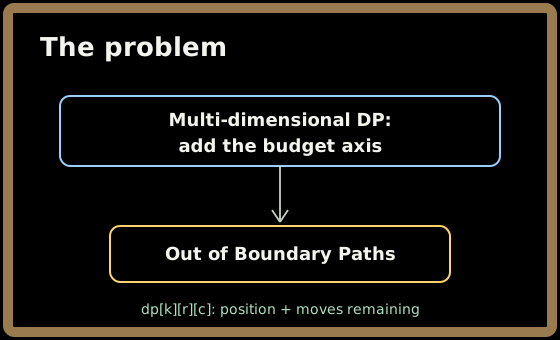
- Out of Boundary Paths — count ways a ball exits an
m×ngrid withinmaxMovemoves; the state is(moves-left, row, col)and off-grid transitions are exactly what you tally (mod 1e9+7).
Key takeaways
- A budget/time constraint becomes a DP dimension —
dp[k][r][c]. - Same neighbor-spreading recurrence as grid DP, decrementing the budget each step.
- Roll on the budget axis to keep memory at O(m·n).
- Why interviewers love it: it tests whether you can identify all the state a transition truly depends on.
Problem: Out of Boundary Paths.