The AI-Native Mindset — Part 1: Why Thinking Beats Typing
maang.io AI-Native Builder Series
What is this?
Imagine you walk into a professional kitchen on your first day, and you're not a line cook — you're the head chef. Standing in front of you is the fastest, most tireless cook in the world. This cook has memorized every recipe ever written, can chop an onion in two seconds, and never gets tired. There's just one catch: this cook has no taste and no judgment. Tell them "make it good" and they'll stare at you. Tell them "dice the onion" without saying how fine, and you might get one giant chunk or a puddle of mush. They'll do exactly what you say, instantly and flawlessly — which means the entire quality of the meal now rests on how clearly you can describe what you want, and whether you can taste the result and send it back when it's wrong.
That cook is an AI coding tool — Claude Code, Cursor, Codex. For most of computing history, the slow, hard, valuable part of building software was typing the code — knowing the exact syntax, remembering which function does what, getting the semicolons right. That bottleneck is gone. The code now appears in seconds. So the job didn't disappear; it moved up a level. Your value is no longer in your fingers. It's in your head: knowing what dish to make, describing it precisely enough to build, and tasting it to know if it's right.
The one-line idea: when AI can write the code, the scarce and valuable human skill becomes knowing what to build, how to ask for it precisely, and how to tell whether it's right.
That head-chef image — you direct a brilliant-but-tasteless cook — is the analogy we'll return to all course long. Let's earn it.
1. The bottleneck moved
Think about what used to make programming hard. It wasn't usually the idea — "show a list of habits and let me check them off" is easy to imagine. The hard part was the translation: turning that idea into hundreds of lines of exact, unforgiving syntax, where one misplaced bracket breaks everything. Learning to code mostly meant learning to survive that translation. Whole careers were built on typing it faster and with fewer bugs.
A bottleneck is the narrowest point in a process — the part that limits how fast the whole thing can go. For decades, typing the code was the bottleneck. Now an AI can produce that translation faster and more accurately than any human. So the bottleneck moved somewhere new.
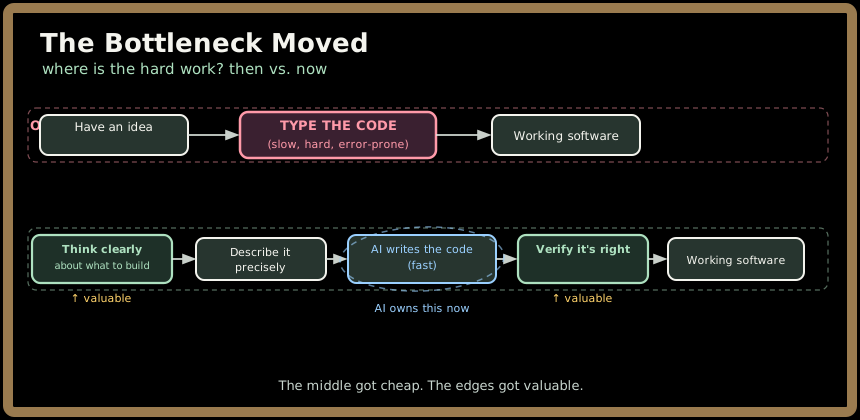
Look at where the hard work sits in each row. In the old world, the human's effort went into the middle box — typing. In the new world, the AI owns that box, and the human's effort moves to the ends: thinking clearly up front, and verifying carefully at the back. The middle got cheap. The edges got valuable.
This is not a small tweak. It's the same kind of shift as when calculators arrived: arithmetic by hand stopped being the skill, and knowing which calculation to run and whether the answer makes sense became the skill. Calculators didn't end math — they raised it. AI doesn't end software engineering. It raises it.
Quick check before moving on:
2. The four skills that matter now
If typing isn't the job, what is? Four things. This course is organized around them, so meet them now — we'll come back to this list constantly.
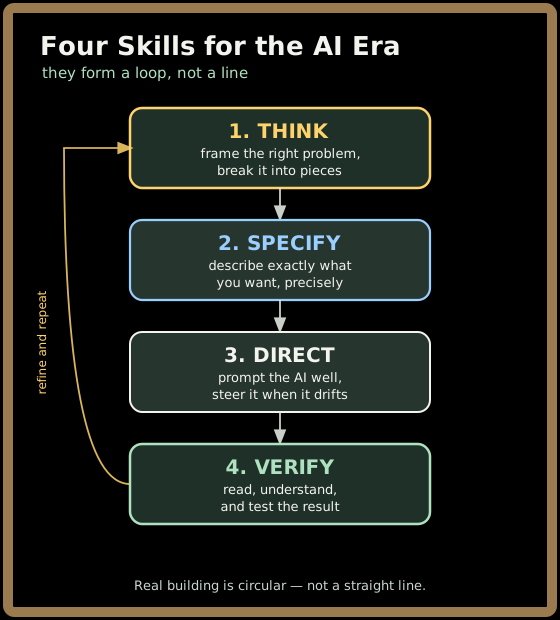
Think. Before any code exists, someone has to figure out what problem is even worth solving, who it's for, and how to break a big fuzzy goal ("a habit tracker") into small, clear pieces ("a screen that lists habits," "a button that marks one done"). The AI will not do this for you. Point a coding tool at "make me an app" and you'll get a confident, generic, useless mess. Thinking is your job.
Specify. A vague request gets a vague result. "Add login" could mean a dozen different things. "Let a user sign up with an email and password, show an error if the email is already taken, and keep them logged in for 30 days" is something an AI — or a human teammate — can actually build correctly. Specifying is the craft of removing ambiguity. Half this course (the entire 101 tier) is devoted to it.
Direct. Even with a clear spec, the AI is a junior partner, not a mind reader. You'll prompt it, watch it produce something close, and steer: "good, but the date should be the user's local time, not the server's." Directing is the back-and-forth of keeping a fast, eager, literal-minded helper pointed at what you actually meant.
Verify. This is the one beginners skip and professionals never do. The AI's code looks confident and runs — but does it do the right thing? Does it break when the input is weird? Can you explain what it does? Verifying means reading the output, understanding it, and testing it. If you can't explain what your code does, you don't get to ship it. That rule runs through every chapter of this course.
You'll notice these four form a loop, not a straight line. You think, specify, direct, verify — then what you learn from verifying sends you back to think again. Real building is circular.
3. The trap: "vibe coding"
There's a tempting failure mode that we need to name so you can avoid it. It's sometimes called "vibe coding": you type a vague request, the AI spits out code, it seems to run, and you move on — never actually reading or understanding what you got. You're coding on vibes. It feels incredibly productive. For about a day.
The exact same AI code can send you down two very different roads. The fork isn't the code — it's whether you understood it:
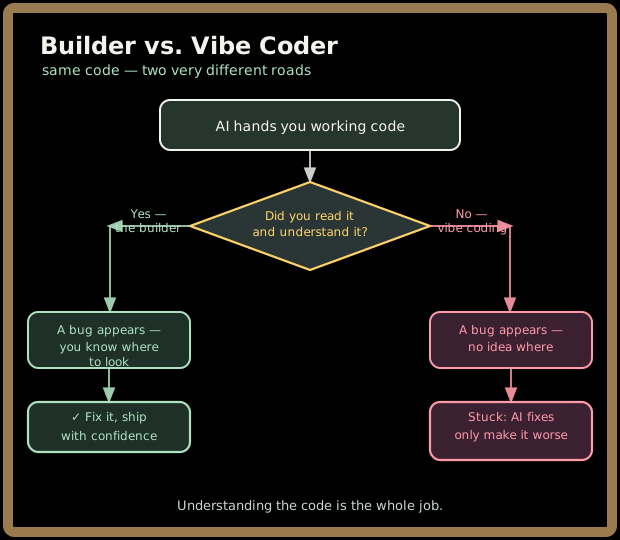
⚠️ Vibe coding works right up until it doesn't — and then it fails catastrophically, because you've built a tower of code you don't understand and can't fix. A bug appears and you have no idea where to look. The AI's "fix" makes it worse. You can't tell good output from bad because you never understood the good. You've outsourced not just the typing, but the thinking — and the thinking was the whole job.
💡 Here's the mental test that separates a builder from a vibe coder: can you explain, in plain language, what each part of your app does and why? If yes, the AI is your tool. If no, you've become the tool's assistant — and you'll be stuck the moment it gets something wrong, which it will.
The good news: avoiding this trap is a skill you can learn, and learning it is most of what this course teaches. You will use AI for almost everything. You will also understand everything you ship. Those two facts are not in tension — they're the entire point.
Quick check before moving on:
4. What this means for how you'll learn
You might be wondering: if the AI writes the code, do I still need to learn how code works? Yes — more than ever, just differently. A film director doesn't operate the camera, but a director who doesn't understand lenses, lighting, and editing makes bad films and gets ignored by the crew. You can't direct what you don't understand.
So here's the deal this course makes with you:
- You'll learn real concepts deeply — what an API is, how a database stores data, why we test, what "deploying to the cloud" actually means. These are the things you direct with. They don't go out of date when the tools change.
- The AI carries the heavy implementation — the hundreds of lines of boilerplate, the framework-specific syntax, the tedious wiring. This is what lets a beginner ship a real, multi-part app in a single summer, which was impossible a few years ago.
- You'll prove understanding, not typing. Throughout, you'll keep a build journal: what you asked the AI, what it gave you, and what you had to fix. That journal is where your thinking becomes visible — and it's worth more than a screen that happens to work.
🚫 What we will not do is teach you to memorize syntax you can look up in a second, or to write code by hand that a tool writes better. That was the old curriculum. It's not yours.
5. You are the director
Let's lock in the mental model you'll carry from here to the final demo. Picture every layer of building software, and where you sit:
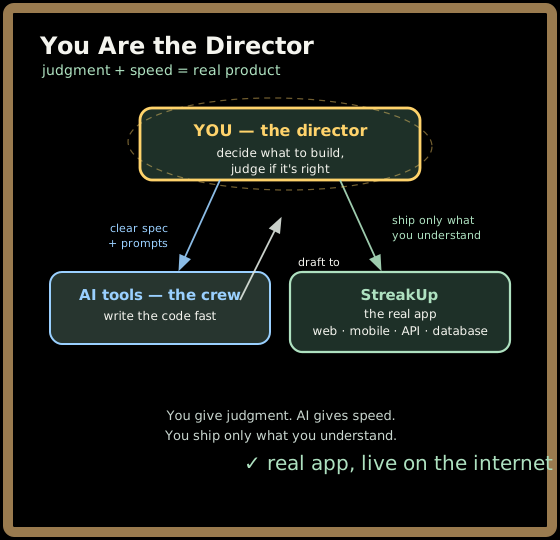
You give direction and judgment. The AI supplies speed and tireless execution. And out the other end comes StreakUp — a real habit-tracking app you'll build end to end and deploy to the internet over the next eight weeks. (You'll meet StreakUp properly in Part 3.)
The shift from "I write code" to "I direct the writing of code, and I own whether it's right" is the whole mindset. Everything else in this course is practice at doing it well.
Key takeaways
- The hard, valuable part of building software used to be typing the code. AI tools removed that bottleneck, so the value moved to the ends of the process: thinking up front and verifying at the back.
- Four skills now matter most — Think, Specify, Direct, Verify — and they form a loop, not a line. This course is built around them.
- Beware vibe coding: accepting code you don't understand. It feels fast and collapses the moment something breaks. The test of a builder is being able to explain what your code does and why.
- You still learn concepts deeply — you can't direct what you don't understand — but the AI carries the heavy implementation, which is what makes shipping a real app in one summer possible.
- Your role is the director: you bring judgment and clear direction; the AI brings speed. You ship only what you understand.
Test yourself on this part's key ideas:
Your turn
You don't have StreakUp yet — but the mindset starts now. In a fresh note (this is the first entry in your build journal):
- Write down one app idea of your own in a single sentence — something you wish existed.
- Under it, list three things you'd have to think about before any code could be written (Who is it for? What's the one thing it must do? What would make it actually good?).
- Write one sentence on what would make you trust that a finished version was "right." That instinct — knowing what right looks like — is the verifying skill, and you already have the beginnings of it.
In Part 2, we'll zoom out from the mindset to the actual process: how real software gets built today, the loop professionals run, and exactly where the AI fits into each step.