Apache Lucene — Part 1: Foundations & Core Concepts
maang.io System Design Series
What is this?
Open any thick reference book and flip to the back. There's an index: an alphabetical list of terms, each followed by the page numbers where that term appears. When you want every mention of "mitochondria," you don't read all 900 pages — you jump to "mitochondria" in the index, read off pp. 44, 217, 588, and turn straight to those pages. The index was built once, ahead of time, precisely so that every future lookup is nearly instant.
Apache Lucene is that back-of-the-book index, built for the whole internet's worth of text, in software. It's a library — a chunk of Java you embed in your program, not a server you talk to over the network — and it does one thing extraordinarily well: given millions of documents, it lets you find the handful that contain your words, ranked by how well they match, in single-digit milliseconds. It is the quiet engine underneath Elasticsearch and Apache Solr (both are essentially networked, distributed wrappers around Lucene), and it powers search inside countless apps you've used without knowing it.
We'll keep coming back to that back-of-the-book image for the whole topic, because almost every clever thing Lucene does is a refinement of it.
The one-line idea: Lucene flips the data around. Instead of storing "document → the words in it" (which forces you to scan every document to find a word), it stores the inverted index: "word → the list of documents that contain it." Building that map once makes every search a fast lookup instead of a full scan.
Let's see why that inversion is such a big deal.
1. Why Lucene exists — the problem it solves
Imagine you have 10 million product reviews and a user searches for waterproof jacket. The naive approach is a linear scan: read every review, check whether it contains both words, collect the matches. That's a SELECT ... WHERE body LIKE '%waterproof%' — and it's a disaster. It reads all 10 million rows for every query, can't use an ordinary database index (a B-tree index on the whole text is useless for "contains a word in the middle"), and it gives you no notion of which matches are best.
This is the pain Lucene removes, and it removes it in two parts:
- Speed, via the inverted index. Build the word → documents map once at index time. Now
waterproofis a single lookup that hands you the exact list of matching documents. Searching 10 million or 10 billion documents costs about the same per term — you touch only the documents that actually contain the word, never the ones that don't. - Relevance, via scoring. A search isn't a yes/no filter; it's a ranking. A review that says "waterproof" five times in a short body about jackets should rank above one that mentions it once in a 5,000-word essay about tents. Lucene computes a relevance score for every match and returns them best-first. That ranking is the difference between "search" and "grep."
Before Lucene-style engines, teams either suffered the LIKE scan, bolted on clumsy database full-text features, or hand-rolled their own index. Lucene (started by Doug Cutting in 1999) packaged the hard parts — the index format, the text analysis, the scoring math — into a reusable, ferociously optimized library. That's why nearly every search product you can name is either Lucene or a deliberate re-implementation of the same ideas.
Quick check before moving on:
2. The core vocabulary — your mental model
Five terms carry the whole topic. Learn these and the internals in Part 2 will click.
Document. The unit you search for — a product, a review, a log line, an email. In Lucene a document is just a bag of fields (title, body, price, tags). Note the mismatch with a relational row: Lucene is schema-flexible and every field can be treated differently.
Field. A named value inside a document, plus instructions on what to do with it. The same title text can be indexed (broken into searchable terms), stored (kept verbatim so you can show it back), and given doc values (a columnar copy for sorting and faceting) — independently. You choose per field.
Term. A single indexed token — usually one normalized word. waterproof is a term. Terms are the keys of the inverted index; everything you can search for is a term (or a combination of them).
Posting list. The value attached to a term in the index: the sorted list of document ids that contain that term, and for each, extra data like how many times it appears (the term frequency) and at which positions (so phrase searches like "waterproof jacket" can check the words are adjacent). "The posting list for waterproof" is exactly the "pp. 44, 217, 588" from the book index — just richer.
Segment. Lucene doesn't keep one giant index file; it keeps a set of smaller, self-contained, immutable mini-indexes called segments. A segment is a complete little inverted index over a batch of documents. New documents create new segments; old segments are never edited in place. This immutability is the heart of Part 2 — and it's the very same design bet you met in the Apache Cassandra topic, where immutable SSTables play the same role.
Here's the whole model in one picture — documents go in, get broken into terms, and the inverted index maps each term back to the documents:
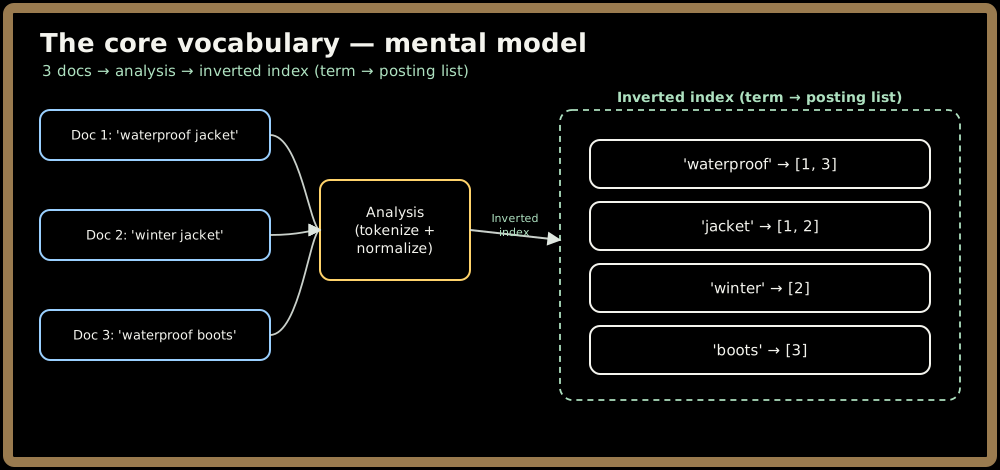
A search for waterproof jacket looks up waterproof → [1, 3] and jacket → [1, 2], intersects or unions them depending on the query, and ranks the result. Doc 1 (both terms) beats Doc 2 and Doc 3 (one term each).
3. The analysis pipeline — turning text into terms
There's a subtle step hiding in that diagram: the box labelled Analysis. Raw text is not what goes into the inverted index. If it were, a search for Jacket wouldn't match a document that says jackets, and WATERPROOF wouldn't match waterproof. The job of the analyzer is to turn messy human text into clean, consistent terms — and, crucially, to do the exact same transformation at index time and at query time, so the two always meet in the middle.
An analyzer is a small pipeline with three stages:
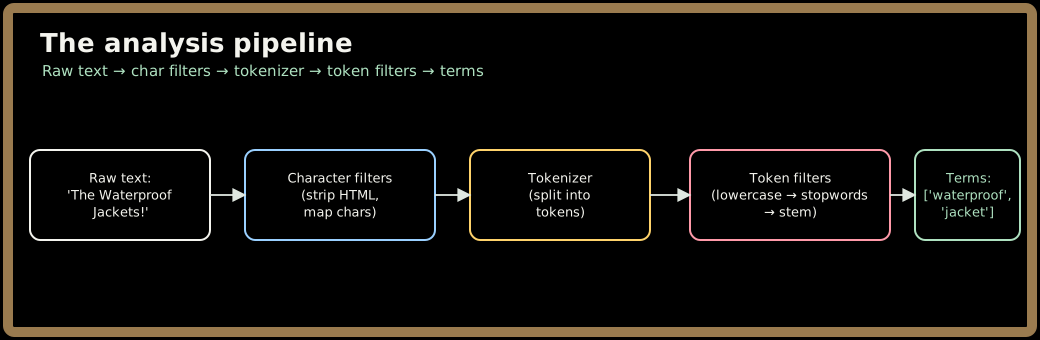
- Character filters (optional) clean the raw string before tokenizing — e.g. strip HTML tags, or normalize
&toand. - The tokenizer splits the stream into tokens, usually on whitespace and punctuation.
The Waterproof Jackets!→[The, Waterproof, Jackets]. - Token filters transform the token stream, in order:
- lowercasing →
[the, waterproof, jackets], so case never matters. - stop-word removal drops ultra-common, low-signal words like
the,a,and→[waterproof, jackets]. (Modern engines often keep stop words, because BM25 scoring already discounts them — see Part 2 — but the option is classic Lucene.) - stemming reduces words to a root so variants match:
jackets→jacket,running→run. Now a query forjacketmatches a document that only saidjackets.
- lowercasing →
The single most important rule: the same analyzer runs on both sides. Index Jackets and it's stored as the term jacket; search JACKET and it's analyzed to jacket; they match. Get the two analyzers out of sync — a classic footgun — and searches mysteriously return nothing even though the words are "right there."
⚠️ Analysis is lossy on purpose, and that's a trap for beginners. Once you stem
universityanduniverseto the same root, you can't tell them apart at search time — over-aggressive stemming or stop-word lists silently hurt relevance. This is why fields are often indexed twice (once analyzed for matching, once as a rawkeywordfor exact filters and sorting).
Quick check before moving on:
4. How you actually use it — a tiny example
Because Lucene is a library, "using it" means calling Java classes, not sending JSON. The shape is always the same: build an IndexWriter, add Documents, then open an IndexSearcher and run a Query. Illustratively:
// --- Indexing side ---
IndexWriter writer = new IndexWriter(dir, new IndexWriterConfig(new StandardAnalyzer()));

Document doc = new Document();
doc.add(new TextField("title", "Waterproof Rain Jacket", Field.Store.YES)); // analyzed + stored
doc.add(new StringField("sku", "RJ-2201", Field.Store.YES));                // NOT analyzed (exact)
doc.add(new FloatDocValuesField("price", 89.90f));                          // for sorting/faceting
writer.addDocument(doc);
writer.commit();   // make it durable

// --- Search side ---
IndexSearcher searcher = new IndexSearcher(DirectoryReader.open(dir));
Query q = new QueryParser("title", new StandardAnalyzer()).parse("waterproof jacket");
TopDocs top = searcher.search(q, 10);   // best 10, already ranked by relevance
Notice the field-by-field choices doing real work: TextField is analyzed into terms (so waterproof matches), StringField is a single exact term (a SKU you filter on, never stem), and the DocValuesField is the columnar copy that makes "sort by price" cheap. That per-field control is Lucene's superpower — and the reason Elasticsearch's mappings look the way they do, because they're a thin JSON skin over exactly these choices.
In practice most engineers never touch this API directly — they use Elasticsearch or Solr, which run this loop on a cluster and expose it as a REST API. But knowing that a TextField becomes a posting list and a DocValuesField becomes a column is what lets you reason about why an Elasticsearch query is fast or slow. We take that all the way down in Part 2.
5. When to reach for Lucene — and when not
Lucene is the right tool when the problem is full-text search and relevance ranking over a corpus that changes far less often than it's queried:
- Text search with ranking: product catalogs, documentation, email, support tickets, code search — anywhere users type words and expect the best matches first.
- Log and event search: the "E" workloads (via Elasticsearch) — grep-like search across billions of log lines, which is why the Logstash and observability stacks lean on it.
- Faceted / filtered search: "show me waterproof jackets under $100, brand = Acme, sorted by rating" — text match plus structured filters, facets, and sorting, all in one engine.
- Fuzzy, prefix, and phrase matching: typo-tolerance, autocomplete,
"exact phrase"queries — things aLIKEclause can't do well.
Reach for something else when the workload isn't really search:
| You need… | Reach for instead | Why |
|---|---|---|
| The system of record / transactions | PostgreSQL, Cassandra, DynamoDB | Lucene is a secondary index, not a durable primary store with ACID/consistency guarantees. |
| Exact key/value lookups, no ranking | Redis, RocksDB, a B-tree DB | An inverted index is overkill when you already know the key. |
| Heavy analytical aggregations over columns | Azure Synapse, a columnar OLAP store | Doc values help, but a real column store crushes big GROUP BY. |
| Graph traversals | Neo4j | "Friends of friends" is not a text-search shape. |
💡 The rule of thumb: Lucene is a search index that sits beside your source of truth, not in place of it. You keep the authoritative data in a database and feed a copy into Lucene/Elasticsearch to make it searchable. When the two disagree, the database wins and you re-index. Treating Lucene as your primary datastore is a classic mistake — it has no transactions, and "the index" is always a derived, rebuildable view.
6. Key takeaways
- Lucene is an embeddable search library — the inverted-index engine inside Elasticsearch and Solr — not a database and not a server.
- The core trick is inversion: store
term → list of documents(the posting list), built once at index time, so every search is a fast lookup instead of a full scan, and results come back ranked by relevance, not just filtered. - The analyzer turns text into terms (character filters → tokenizer → token filters: lowercase, stop words, stemming) and must run identically at index and query time, or matches silently vanish.
- Fields are configured independently — indexed (searchable terms), stored (returned verbatim), and doc values (columnar, for sort/facet) — which is where all of Lucene's flexibility comes from.
- Use it for full-text search and ranking beside a source of truth, not as your primary datastore; the index is always a derived, rebuildable view.
Test yourself on this part's key ideas:
Next, Part 2 goes under the hood: the immutable segment engine (the same immutability bet as Cassandra's SSTables), the FST that stores the term dictionary in a few bytes, how a posting list is compressed and skipped through, and the scoring math — TF-IDF then BM25 — that decides who ranks first.