Asynchronous Messaging — Part 1: Foundations & Core Concepts
maang.io System Design Series
What is this?
Imagine a busy office with a mailroom in the middle. When Alice needs to get a document to Bob, she doesn't walk to Bob's desk, stand there, and wait for him to read it, react, and hand something back before she can get on with her day. That would be absurd — Bob might be in a meeting, at lunch, or drowning in work. Instead Alice drops the envelope in the mailroom's outgoing tray and walks away, free to do her next task. The mailroom holds the letter safely, figures out where it goes, and delivers it whenever Bob is ready to collect his mail. Bob processes it on his own schedule. Neither of them ever has to be at their desk at the same moment.
That mailroom is a message broker, and this whole arrangement — drop it off, walk away, let someone else pick it up later — is asynchronous messaging. It's how you get two parts of a software system to talk without forcing them to be online, fast, or even alive at the same instant.
The one-line idea: Asynchronous messaging decouples a producer from a consumer in both time and space — the sender hands a message to a broker and moves on immediately, and the receiver processes it later, at its own pace. Neither knows or waits for the other; the broker in the middle absorbs the difference.
We'll keep coming back to this mailroom for the whole topic. Let's start with why anyone would want it.
1. Why it exists — the pain of doing it synchronously
Picture the classic e-commerce checkout. A customer clicks "Place order." Behind that one click, you'd love to: charge the card, reserve inventory, send a confirmation email, generate an invoice, notify the warehouse, update the recommendation model, and ping the fraud system. The naive design does all of it synchronously — the web request calls each service in turn and only returns "Order placed!" once every last one has finished.
This is the "walk to Bob's desk and wait" model, and it has four nasty properties:
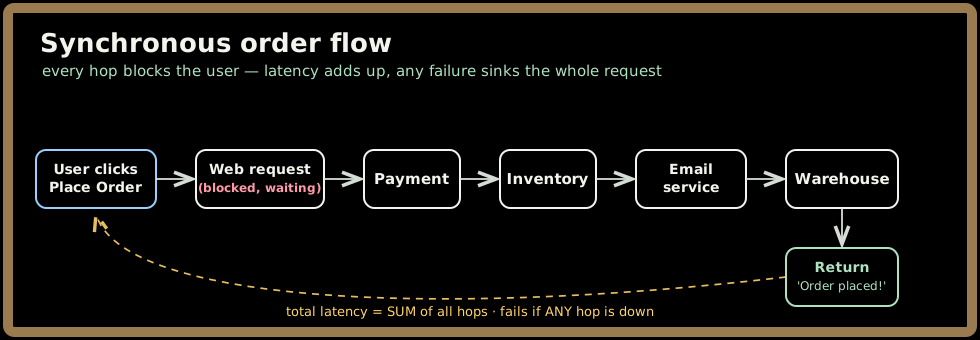
- Latency stacks up. The user waits for the sum of every downstream call. Slowest link sets the speed.
- Tight coupling. The checkout code must know every downstream service, its address, and its API. Add a "loyalty points" step and you edit checkout.
- Fragility — failure cascades. If the email service is down, the whole order fails, even though emailing has nothing to do with whether the order is valid. One weak link breaks the click.
- No load smoothing. A Black-Friday spike hits every downstream service at full force, simultaneously, in real time. If the fraud system can handle 1,000/s and you get 5,000/s, requests just fail.
Asynchronous messaging fixes all four at once. Checkout does the one thing that genuinely must happen before you tell the user "success" (say, take the payment), then drops a message — OrderPlaced — into the broker and returns immediately. Email, warehouse, invoicing, recommendations each subscribe and do their part later, independently. The click is fast (one hop, not seven), checkout no longer knows who cares about orders, an email outage can't fail an order, and a traffic spike piles up harmlessly in the queue instead of knocking services over.
💡 The rule of thumb: do synchronously only what the user must see resolved before you answer them; make everything else a message. "Did my payment go through?" is synchronous. "Send my receipt" is a message.
2. Core concepts & vocabulary — the mental model
A few terms you'll use constantly. All of them map onto the mailroom.
- Producer (a.k.a. publisher / sender): whoever drops a message off. Checkout, in our example.
- Consumer (a.k.a. subscriber / receiver / worker): whoever picks a message up and acts on it. The email service.
- Message: the envelope's contents — a small, self-contained record of something that happened (
OrderPlaced,id=812,total=$40) or something to do (SendEmail). Usually JSON, Protobuf, or Avro. Keep it small; put big blobs in object storage and pass a pointer (see the Object Storage (S3 & Azure Blob) topic). - Broker: the mailroom itself — the server (or managed service) that receives, stores, routes, and hands out messages. RabbitMQ, Amazon SQS, ActiveMQ, and (in a log-shaped variant) Apache Kafka.
- Delivery guarantee: the broker's promise about how many times a message will reach a consumer — the single most important and most misunderstood concept here (Section 4).
2.1 The two shapes: queue vs pub/sub
Nearly every messaging system is one of two shapes, and knowing which you need is half the battle.
A message queue is point-to-point. One message is delivered to exactly one consumer. If you run five worker instances reading the same queue, each message goes to one of them — they're competing consumers, splitting the work. This is how you distribute a workload: put 10,000 "resize this image" jobs on a queue, run 20 workers, and each grabs the next job when it's free. It's a load-balancer that also buffers.
Publish/subscribe is fan-out. One message is delivered to every interested subscriber. The producer publishes to a topic; every consumer subscribed to that topic gets its own copy. OrderPlaced fans out so that email, warehouse, and analytics each receive it independently. (This has its own dedicated topic — Publish–Subscribe Pattern — go there for the full treatment.)
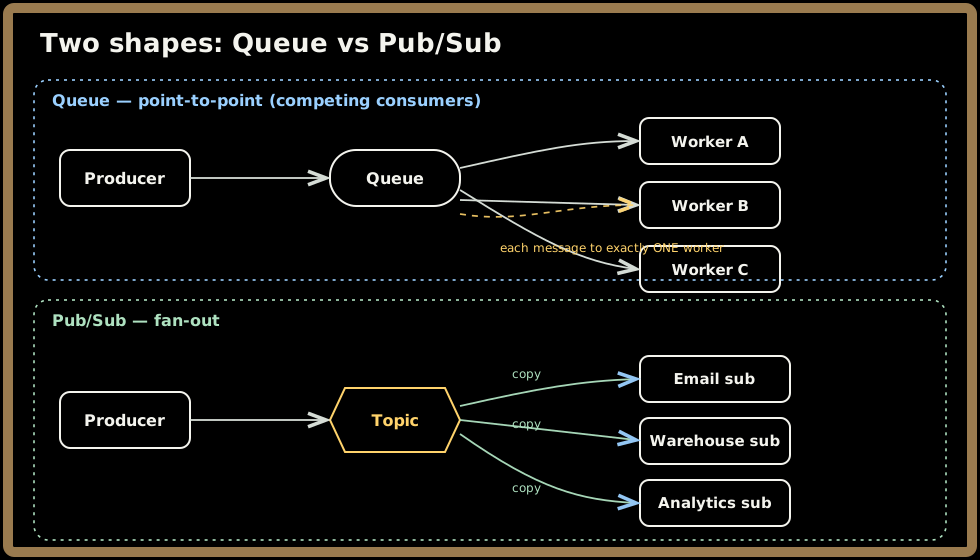
The mailroom captures both: a queue is one physical inbox several clerks take turns emptying; pub/sub is a newsletter the mailroom photocopies and drops into every subscriber's inbox.
💡 Ask yourself: "Should this message be handled once, or seen by many?" Handled once (do a job) → queue. Seen by many (announce a fact) → pub/sub. Many real systems combine them: publish an event to a topic, and each subscriber has its own queue behind it (fan-out to durable per-consumer queues). AWS SNS→SQS is exactly this.
Quick check before moving on:
3. How you actually use it — a concrete example
The API is deliberately tiny: send a message, receive a message, acknowledge it. Here's a producer publishing an order event and a worker consuming it (pseudocode close to the SQS/AMQP shape):
# --- Producer: checkout, after payment succeeds ---
broker.send(
    queue="order-events",
    body={"type": "OrderPlaced", "order_id": 812, "total_cents": 4000},
)
# returns in ~2 ms — checkout is now done and replies to the user

# --- Consumer: the email worker, running in a loop elsewhere ---
while True:
    msg = broker.receive("order-events", wait_seconds=20)   # long-poll
    if not msg:
        continue
    try:
        send_receipt(msg.body["order_id"])
        broker.ack(msg)          # delete it — "I handled this"
    except Exception:
        broker.nack(msg)         # leave it — it'll be redelivered later
Three things to notice, because they define the whole model:
- The producer's
sendreturns almost instantly — it's just handing the envelope to the mailroom, not waiting for the email to be sent. - The consumer explicitly
acks after it succeeds. Until it does, the broker considers the message in-flight, not done. If the worker crashes mid-processing, no ack ever comes, and the broker redelivers the message to another worker. This is the heart of not losing work. - On failure the worker
nacks (or just does nothing), and the message comes back for another attempt.
That ack step is why messaging is reliable in a way that a plain HTTP call isn't: a message isn't gone until someone confirms they finished it.
Quick check before moving on:
4. Delivery guarantees — the concept everyone gets wrong
When the broker hands a message to a consumer, how many times might that consumer end up processing it? There are exactly three answers, and choosing among them is a core design decision.
| Guarantee | Meaning | You get it by… | Risk |
|---|---|---|---|
| At-most-once | 0 or 1 delivery. Never a duplicate, but a message can be lost. | Ack before processing (or fire-and-forget). | Lost messages. |
| At-least-once | 1 or more deliveries. Never lost, but you can see duplicates. | Ack after processing; redeliver on missing ack. | Duplicate processing. |
| Exactly-once | Processed once and only once. | (Read the ⚠️ below — it's subtler than it sounds.) | Complexity / cost. |
Almost every real broker gives you at-least-once by default, and for good reason: losing a customer's order is far worse than emailing them twice. The trade you accept is that duplicates will happen — a worker processes a message, crashes just before its ack lands, and the broker, seeing no ack, redelivers. Nothing was lost; something was done twice.
⚠️ "Exactly-once delivery" is essentially a myth over an unreliable network — you can't distinguish "the message was lost" from "the ack was lost," so any system that refuses to lose messages must sometimes redeliver. What people actually mean by "exactly-once" is exactly-once processing, and you achieve it by taking an at-least-once stream and making your consumer idempotent — designed so that processing the same message twice has the same effect as processing it once (e.g.
INSERT ... ON CONFLICT DO NOTHINGkeyed byorder_id, or a dedup table of seen message-ids). We'll build this properly in Part 2 and defend it in the interview. For now, memorize the senior framing: exactly-once = at-least-once delivery + idempotent consumers. Anyone who claims a broker gives them true exactly-once for free hasn't hit the edge cases yet.
5. When to reach for it — and when not
Reach for asynchronous messaging when:
- The work can happen later. Emails, notifications, thumbnails, search-index updates, analytics, invoicing — anything the user needn't wait on.
- You need to decouple services so they can deploy, scale, and fail independently, and so producers don't hard-code who consumes.
- You need to absorb spikes (buffer load) or smooth throughput to a downstream that has a fixed rate limit.
- You're fanning one event out to many independent consumers (pub/sub).
- The work is long-running or expensive (video transcoding), so you queue it and let a worker pool chew through it.
Don't reach for it when:
- The caller genuinely needs the answer now — "is this password correct?", "what's my account balance?". That's a synchronous request/response; a queue only adds latency and complexity.
- You need a strict transactional result across services in one user action. Messaging is eventually consistent by nature; if you truly need one atomic commit, that's the Distributed Transactions / Two-Phase Locking territory.
- The system is small and simple and a direct function call or HTTP call is clearer. A broker is real operational weight — don't add one to save three lines.
Alternatives at a glance: a synchronous HTTP/RPC call (need the answer now), Webhooks (push an event to an external party's HTTP endpoint — the outbound cousin of messaging, covered in its own topic), Apache Kafka (when you want a durable, replayable log of events rather than a queue that deletes on ack — its own topic), and Redis Pub/Sub (fire-and-forget fan-out with no durability — fast but lossy).
6. Key takeaways
- Asynchronous messaging decouples producers from consumers in time and space via a broker in the middle — the sender drops a message and moves on; the receiver processes it later, at its own pace. That buys you low latency, loose coupling, fault isolation, and load smoothing.
- Two shapes, one question: handled once (do a job) → a queue with competing consumers; seen by many (announce a fact) → pub/sub fan-out. Real systems often chain them (topic → per-consumer queues).
- The consumer
acks only after it succeeds — that explicit confirmation is what makes messaging reliable, because an unacked message gets redelivered instead of lost. - Delivery guarantees are a real choice: at-most-once (may lose), at-least-once (may duplicate — the sane default), exactly-once (a promise you keep with idempotency, not magic).
- Use it for work that can happen later and for decoupling; don't use it when the caller needs the answer now or when you truly need one atomic cross-service transaction.
Test yourself on this part's key ideas:
Next, Part 2 (Deep Dive & Internal Implementation) opens up the mailroom: how a broker actually stores and routes messages, the exact mechanics of visibility timeouts, redelivery and exponential backoff, dead-letter queues, ordering, and backpressure — with worked numbers you can quote in an interview.