Apache Storm — Part 1: Foundations & Core Concepts
maang.io System Design Series
What is this?
Picture the sorting hub of a parcel company at 2 a.m. Trucks back up to the loading docks and dump packages onto conveyor belts. The belts carry each package past a series of workstations — one scans the barcode, another reads the destination zip, another slaps on a routing label, another drops it into the right outbound chute. Packages stream through continuously; the building never stops, never "finishes." As long as trucks keep arriving, the belts keep moving, and every station does its one small job on every package that rolls past.
That hub is Apache Storm. The loading docks are spouts (they pull raw data in from the outside world). The workstations are bolts (each does one unit of processing). The packages gliding along the belts are tuples — the individual pieces of data. And the whole wired-up arrangement of docks, belts, and stations — laid out as a fixed map of who feeds whom — is a topology. Once you start it, a Storm topology runs forever, chewing through an unbounded stream of events in real time, one tuple at a time.
That last phrase is the whole point. Before Storm, "processing data" mostly meant batch: pile up a day's worth of logs, run a Hadoop MapReduce job overnight, read the answer in the morning. Storm was the first widely-used system to make continuous, low-latency stream processing approachable — its author Nathan Marz literally pitched it as "the Hadoop of real-time."
The one-line idea: Apache Storm is a real-time stream processor that runs a standing dataflow graph — a DAG of data sources (spouts) and processors (bolts) — where tuples flow through continuously and get processed one at a time, within milliseconds of arriving, forever.
We'll carry the parcel-hub picture through all three chapters. By the end you'll know how a package is tracked from dock to chute (the famous acker mechanism), why the hub almost never loses a package, and why — despite being a brilliant design — the industry eventually moved the freight to newer hubs like Apache Flink.
1. Why Storm exists — what was painful before
Rewind to around 2011. If you wanted to compute something over a firehose of events — trending hashtags, fraud signals, live dashboards, per-user click counts — your only mature tool was batch. That meant Hadoop, and Hadoop meant latency measured in hours. You couldn't answer "what's trending right now"; you could only answer "what was trending yesterday."
Teams that needed real-time answers built the same thing over and over, badly: a hand-rolled network of queues and worker processes. A worker read from a queue, did some work, wrote to another queue, another worker read that, and so on. It technically worked, but it was a nightmare that nobody wanted to own:
- Where does a message go if a worker crashes mid-processing? You wrote your own retry logic, every time.
- How do you scale one stage without rewiring the others? You didn't, easily.
- How do you guarantee nothing is silently dropped? You mostly hoped.
- How do you deploy this across 50 machines and restart the dead ones? More custom glue.
Storm's insight was that this plumbing — the queues, the message routing, the parallelism, the fault tolerance, the "did every message actually get processed?" bookkeeping — is the same every time, so the framework should own it. You describe the graph (spouts and bolts); Storm runs it reliably across a cluster and guarantees every tuple is fully processed. You write the two workstations that matter to your business; Storm builds the conveyor belts, hires the staff, and tracks every package.
That was the trade that made Storm spread fast, especially at Twitter (which acquired Marz's company and open-sourced Storm). It became the canonical speed layer of the Lambda architecture — the fast, approximate real-time path running alongside a slow, exact batch path. (You'll meet its natural upstream partner, Apache Kafka, constantly in this chapter — Kafka is where the firehose usually comes from.)
Quick check before moving on:
2. The mental model — core concepts and vocabulary
Everything in Storm is built from a handful of nouns. Learn these five and the rest follows.
Tuple. The unit of data — a named list of values, like a single row: (user_id=42, url="/home", ts=1699…). A tuple is one package on the belt.
Stream. An unbounded, continuous sequence of tuples with a shared schema. This is the key word: unbounded. A batch job reads a finite file and ends; a Storm stream never ends, so the topology never ends either.
Spout. A source of streams — the loading dock. A spout pulls data from the outside (a Kafka topic, a message queue, an API) and emits it into the topology as tuples. Spouts are where data enters.
Bolt. A processor — a workstation. A bolt consumes tuples from one or more streams, does something (filter, transform, aggregate, join, look up a database, write to storage), and optionally emits new tuples for downstream bolts. All actual work happens in bolts. You chain them to build a pipeline.
Topology. The whole graph — a DAG (directed acyclic graph) wiring spouts to bolts to more bolts. This is your program. You submit it to the cluster and it runs indefinitely until you explicitly kill it. (Contrast with a MapReduce job, which is a DAG that runs once and exits.)
Here's a small topology — a word-count over a stream of tweets, the "hello world" of Storm:
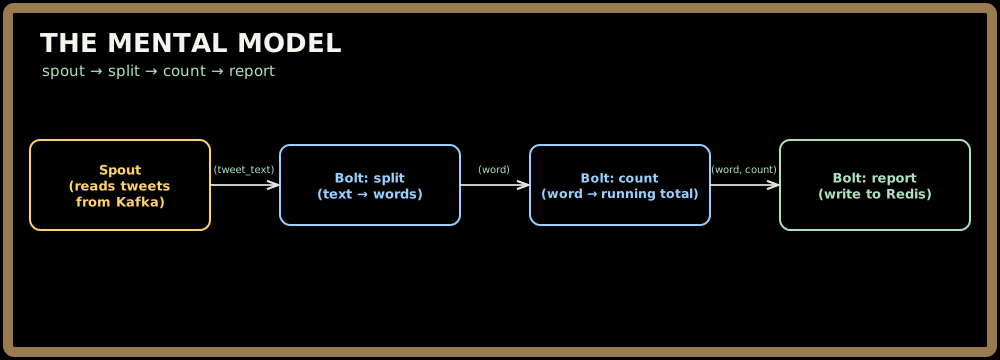
Read it left to right: the spout pulls raw tweets, the split bolt breaks each tweet into words and emits one tuple per word, the count bolt keeps a running tally per word, and the report bolt persists the totals. Tuples flow through in real time — a word tweeted now updates its count within milliseconds.
2.1 Parallelism: tasks
A single workstation would be a bottleneck, so each spout and bolt runs as many parallel instances called tasks. If the split bolt has 8 tasks, eight copies of it run across the cluster, each chewing through a share of the tweets. You set the parallelism per component (setBolt("split", …, 8)), and Storm spreads those tasks across machines. This is how one hub handles a firehose: not one super-worker, but a swarm of identical workers on parallel belts. (Exactly how a task maps to a thread and a process is a Part 2 detail — for now, "task = one parallel instance of a bolt or spout.")
2.2 Stream groupings — the routing rules
Here's the concept that trips people up, so slow down. When the split bolt (8 tasks) emits a word tuple, which of the count bolt's tasks should receive it? That routing decision is a stream grouping, and choosing the right one is a correctness question, not just a performance one. Back at the hub, it's the rule on the conveyor for which chute a package rolls into. The important groupings:
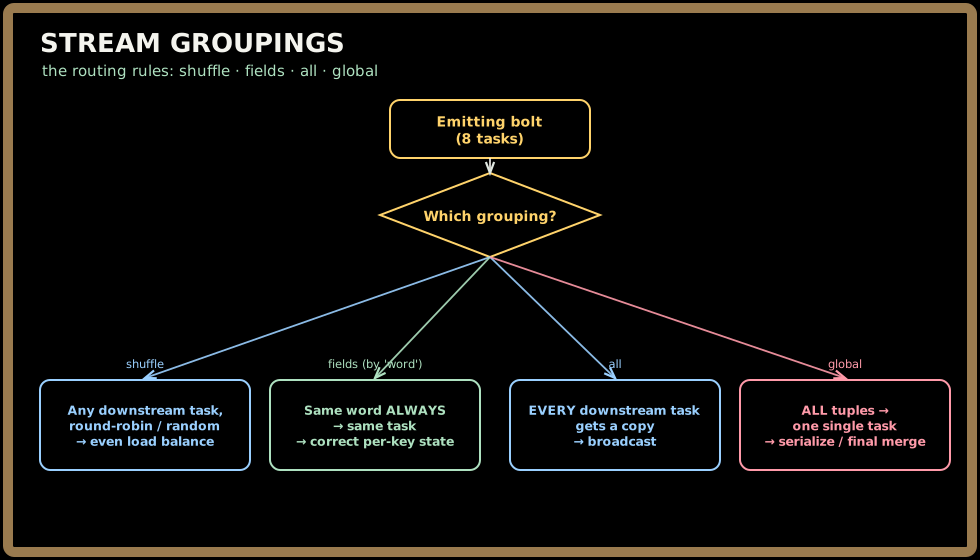
- Shuffle grouping — spread tuples randomly and evenly across the target's tasks. Perfect for stateless work (like split) where any worker can handle any tuple. It load-balances.
- Fields grouping — partition by the value of one or more fields. All tuples with the same field value go to the same task, always. This is the one that makes counting correct: every
("the")tuple must land on the same count task, or you'd have "the" tallied in five different places. Fields grouping is Storm'sGROUP BY, and it's the streaming cousin of the consistent hashing and partitioning ideas from this tier — same value, same owner. - All grouping — broadcast a copy of every tuple to every task. Used for things like pushing a config update or a filter list to all workers.
- Global grouping — send everything to a single task (the one with the lowest id). Used when you need a single point to merge or serialize — rare, and an obvious bottleneck, so use sparingly.
💡 The rule of thumb: shuffle when the work is stateless, fields when you keep per-key state. If a bolt accumulates anything keyed (counts, sums, sessions, dedup sets), you almost certainly need fields grouping on that key, or the same key's state gets scattered across tasks and your answer is wrong. This single decision is the most common correctness bug in a Storm topology.
Quick check before moving on:
3. How you actually use it — a short concrete example
You build a topology in code (Java is idiomatic). You don't write plumbing — you declare components and how they're wired, then submit. Here's the word-count topology, trimmed to the shape that matters:
TopologyBuilder builder = new TopologyBuilder();

// Source: a Kafka spout, 4 parallel instances.
builder.setSpout("tweets", new KafkaSpout(kafkaConfig), 4);

// Stateless split: shuffle grouping is fine — any task can split any tweet.
builder.setBolt("split", new SplitSentenceBolt(), 8)
       .shuffleGrouping("tweets");

// Stateful count: MUST use fields grouping on "word" so each word's
// running total lives on exactly one task.
builder.setBolt("count", new WordCountBolt(), 12)
       .fieldsGrouping("split", new Fields("word"));

StormSubmitter.submitTopology("word-count", conf, builder.createTopology());
Read what each line declares: the spout with 4 tasks, the split bolt with 8 tasks fed by a shuffle of the spout, the count bolt with 12 tasks fed by a fields grouping on word. That's the entire dataflow. The WordCountBolt's actual logic is trivially small — its execute(tuple) method reads the word, bumps a HashMap counter, and emits (word, newCount). Storm handles everything else: distributing 24 tasks across the cluster, moving tuples between them over the network, restarting failed workers, and tracking that every tweet was fully processed.
That inversion — you write two tiny methods, the framework runs a fault-tolerant distributed system — is the developer experience Storm pioneered.
4. When to reach for Storm — and when not
Storm fits a specific shape: a continuous firehose of events that you must react to in near-real-time, tuple by tuple, with per-event latency in the low milliseconds.
Reach for a Storm-style processor when you see:
- Real-time analytics / dashboards — live counts, trending topics, per-minute metrics.
- Continuous ETL — clean, enrich, and route events as they arrive (a natural pairing with Logstash-style pipelines and Kafka).
- Fraud / anomaly detection — score each transaction the instant it happens.
- Real-time alerting — watch a stream for a threshold and fire.
Don't reach for it when:
| You need… | Use instead |
|---|---|
| Batch analytics over a finite, historical dataset | MapReduce / Spark batch / a warehouse (Azure Synapse Analytics) |
| Exactly-once stateful streaming with event-time windows and joins | Apache Flink (or Storm's own Trident layer — Part 2) |
| Simple stream transforms that live inside Kafka | Kafka Streams |
| Just durable message delivery, no processing | A queue / Apache Kafka on its own |
And here's the honest headline you should carry into Part 3: for brand-new systems in the 2020s, you probably wouldn't choose Storm. Its ideas were foundational and its low-latency core is genuinely excellent, but newer engines — chiefly Apache Flink — absorbed those ideas and added the things Storm made hard: exactly-once semantics, first-class managed state, and event-time windowing. Storm still runs in production at places that adopted it early, and understanding it is the key that unlocks why the newer systems are shaped the way they are. That "why streaming moved on" story is a favorite interview thread — we'll arm you for it.
Key takeaways
- Apache Storm is a real-time stream processor: it runs a standing topology (a DAG) of spouts (sources) and bolts (processors), and tuples flow through it continuously, processed one at a time within milliseconds — the "Hadoop of real-time."
- It exists because before Storm, real-time meant hand-rolling fragile networks of queues and workers. Storm owns the hard plumbing — parallelism, routing, fault tolerance, and "was every tuple processed?" — so you just write the bolts.
- Parallelism comes from running many tasks per component; stream groupings decide how tuples are routed between them — shuffle (even load balance, stateless work) vs fields (same key → same task, required for correct per-key state).
- You declare the graph (spouts, bolts, parallelism, groupings) and submit it; Storm runs it forever across the cluster until you kill it.
- Reach for it on a low-latency, continuous-event shape — but know that Apache Flink has largely superseded it by adding exactly-once, managed state, and event-time. Learning Storm is how you understand the whole streaming lineage.
Test yourself on this part's key ideas:
Next, Part 2 (Internals & Implementation) opens up the hub: Nimbus, supervisors, workers, executors, and tasks; the beautiful acker mechanism that tracks a tuple's entire journey using a single XOR checksum to guarantee at-least-once delivery; and how Trident buys you exactly-once on top.