Gossip Protocol — Part 1: Foundations & Core Concepts
maang.io System Design Series
What is this?
Picture a huge open-plan office — a few thousand people, no intercom, no all-hands email. Someone in the corner learns a juicy piece of news: "the coffee machine on floor 3 is broken." How does everyone find out? Nobody stands on a desk and shouts to all 3,000 people at once — that's exhausting and if their voice gives out, half the office never hears. Instead, something far lazier happens. Every so often — say every 30 seconds — each person turns to one random colleague and swaps everything they've heard lately. Person A tells B, then B tells C and D, and C tells three more, and within a couple of minutes the whole building knows about the coffee machine. Nobody was in charge. Nobody had a megaphone. The news spread like a rumor — or, if you prefer the epidemiologist's word, like a virus.
That's a gossip protocol (also called an epidemic protocol or anti-entropy protocol). In a distributed system of hundreds or thousands of nodes, there's no reliable "shout to everyone" — a central broadcaster is a bottleneck and a single point of failure. So instead, every node periodically picks a few random peers and exchanges state with them. Information spreads node-to-node, exponentially, until the whole cluster converges on the same view. It's how a masterless system like Apache Cassandra (covered in its own topic in this tier) knows which nodes are alive, who owns which data, and when a peer has died — all with nobody in charge.
The one-line idea: don't broadcast from the center — infect. Each node repeatedly whispers what it knows to a handful of random peers, and the truth spreads through the cluster like a rumor through an office: exponentially fast, with no coordinator, and no single point of failure to knock the whole thing offline.
Let's unpack why this beats the obvious alternatives, then build the vocabulary you'll need for the internals in Part 2.
1. Why it exists — the problem with shouting
Say you have a cluster of N nodes, and one of them needs to tell everyone something: "node 7 just died," or "I now own this range of keys," or "the schema changed." What are your options?
- Central broadcaster. One coordinator node holds the truth and pushes updates to all
Nnodes. Simple — until that coordinator becomes a bottleneck (it doesNsends every update), or it dies (now nobody knows anything), or the network to it partitions (half the cluster goes blind). You've reinvented the single point of failure that masterless systems exist to avoid. - Everyone talks to everyone. Each node directly tells all
N-1others. Now every update isN × (N-1)messages — that'sO(N²). At 1,000 nodes that's a million messages per update. It melts the network and doesn't tolerate loss: if one message drops, that node silently misses the news. - Gossip. Each node tells a fixed small number of random peers each round, and they retell it, and so on. Per node the work is constant (a couple of messages per round regardless of cluster size), the total load is spread evenly, there's no coordinator to lose, and it's naturally fault-tolerant — if one exchange drops a message, the same news arrives via three other paths a moment later.
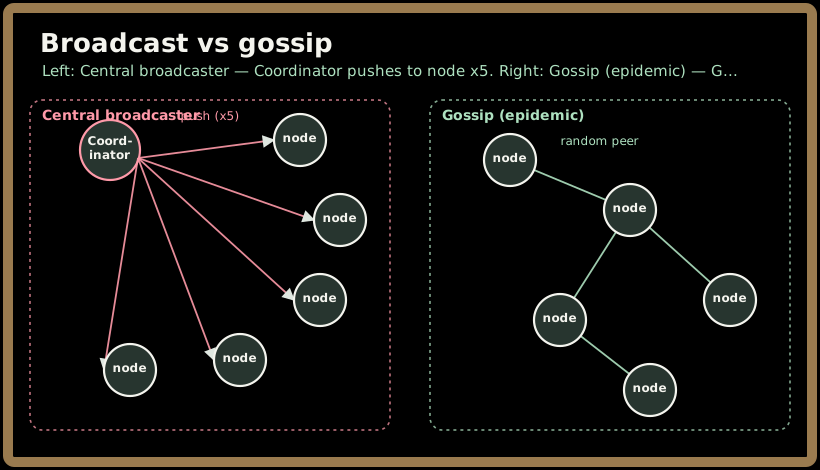
The gossip win in one line: constant per-node cost, no coordinator, and redundancy for free. The price — and there's always a price — is that gossip is eventually consistent. Nobody knows the exact instant the whole cluster has heard the news; you only know it will, soon, with overwhelming probability. For membership and failure detection, "soon and certain" beats "instant but fragile" every time. (This is the same availability-over-strict-consistency bet you met in the CAP chapter in the 101 tier.)
Quick check before moving on:
2. The core mental model & vocabulary
Keep the office rumor in your head and attach the real terms to it.
- Node / peer / endpoint. A member of the cluster (one person in the office). Each one runs the gossip loop.
- Gossip round (or cycle). The periodic tick — in Cassandra, once per second — when a node wakes up, picks its random peers, and exchanges state. (Every 30 seconds, each person swaps news with a colleague.)
- Fanout. How many peers a node contacts per round. Cassandra contacts up to ~3. Small fanout still converges fast, because the retelling compounds.
- State / heartbeat. What's being spread. Usually not "one rumor" but a bundle: is each node alive, what's its load, which data ranges does it own, what version of the schema does it have. Liveness is tracked with a heartbeat — a counter each node bumps every round to say "still here."
- Version number. Every piece of state carries a monotonically increasing version, so when two nodes disagree, they can tell which value is newer and keep it. This is how gossip reconciles conflicting views without a coordinator. (Same last-writer-wins-by-version instinct behind conflict resolution in Replication.)
- Convergence. The moment every node's view agrees. Gossip guarantees it eventually; the whole game is making "eventually" mean "a few seconds."
- Anti-entropy. The formal name for "keep exchanging until the differences (the entropy) between two nodes' state is gone." Gossip is an anti-entropy protocol.
Push, pull, and push-pull
There are three flavors of a single exchange, and the difference matters for speed:
- Push: "Here's what I know — take it." A node that has fresh news sends it to a random peer. Great early on, when few nodes know the news and any random peer probably doesn't yet.
- Pull: "What do you know? Tell me." A node asks a random peer for their state. Great late in the spread, when most nodes already have the news, so a node that's still missing it will likely pull from someone who has it.
- Push-pull: both directions in one round trip — "here's mine, now give me yours." This is the fastest and what real systems use. Cassandra's gossip is push-pull, implemented as a three-message handshake we'll dissect in Part 2.
💡 Rule of thumb: push wins the early race, pull wins the endgame, push-pull wins both — so production systems just always do push-pull and stop worrying about which phase they're in.
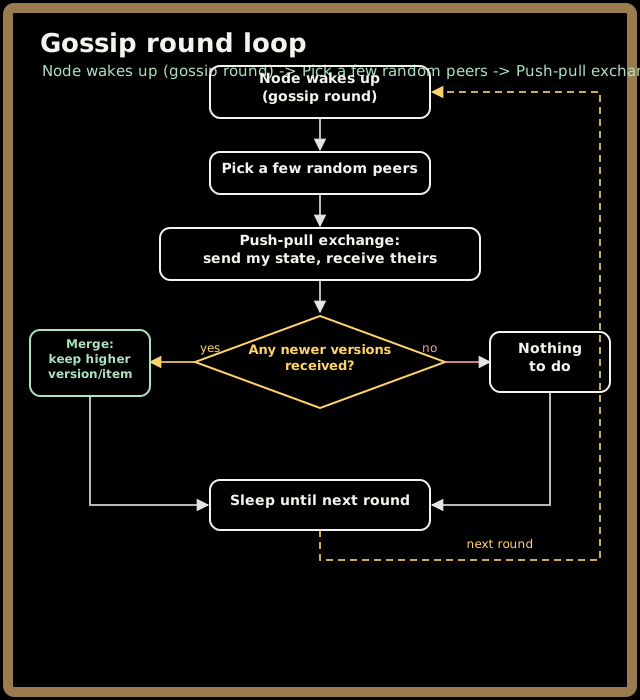
That loop, running independently on every node once a second, is the entire protocol. No leader, no schedule, no coordination — just a lot of nodes each doing the same tiny, selfish thing, out of which a globally-consistent view emerges.
Quick check before moving on:
3. How you actually use it
Here's the good news for an application engineer: you almost never call a gossip API directly. Gossip is infrastructure plumbing inside the datastores and coordination tools you already use. You configure it and you reason about it; you rarely code against it.
What it looks like in practice is a couple of tuning knobs. In Cassandra, for example, the gossip loop and the failure detector are governed by settings like these (illustrative, in cassandra.yaml):
# Nodes to contact when a fresh node joins, to bootstrap into the gossip mesh.
# Seeds are NOT special masters — just well-known entry points everyone can find.
seed_provider:
  - class_name: org.apache.cassandra.locator.SimpleSeedProvider
    parameters:
      - seeds: "10.0.0.1,10.0.0.2"

# How suspicious we must be before declaring a peer dead (see Part 2 — phi accrual).
# Higher = more patient (fewer false deaths), slower to detect real ones.
phi_convict_threshold: 8
And when you operate the cluster, you observe gossip's output. In Cassandra, nodetool gossipinfo dumps each node's gossiped state — its generation, heartbeat version, status (NORMAL, LEAVING, MOVING), load, and owned tokens. Tools built on the Serf library (like HashiCorp Consul) expose their gossip membership the same way — consul members is literally "show me who the gossip layer currently believes is alive."
So "using" gossip means three things: seed new nodes so they can find the mesh, tune the failure detector for your network's jitter, and trust the eventually-consistent membership view when you design around it (e.g., don't assume a just-joined node is instantly visible everywhere — give it a few seconds to gossip in).
4. When to reach for it — and when not
Gossip is the right tool for a very specific job: spreading small, eventually-consistent, cluster-wide metadata among many peers with no coordinator.
Reach for gossip when:
- Membership & failure detection at scale — "who's in the cluster and who's alive?" This is its killer app. Cassandra, DynamoDB, Consul/Serf, Riak, ScyllaDB, and Redis Cluster all use it here.
- Disseminating small metadata — schema versions, token/ownership maps, node load, config. Things that are small, change occasionally, and where a few seconds of lag is fine.
- No central authority is acceptable — you specifically want to avoid a coordinator that could bottleneck or fail.
Do not reach for gossip when:
- You need strong agreement / consensus — "elect exactly one leader," "commit this value only if a majority agrees," "linearize these operations." Gossip is eventually consistent; it can't decide. That's what Paxos and Raft are for (Paxos has its own topic in this tier). Cassandra even makes this split explicit: gossip for membership, but Paxos-backed lightweight transactions for compare-and-set.
- You need to move bulk data — gossip spreads facts about data (versions, digests, liveness), not the data itself. Reconciling the actual rows is a job for Replication and Merkle-tree-based repair (which gossip triggers but doesn't perform).
- You need instant, exact propagation — gossip trades latency and certainty-of-timing for robustness. If you need "the instant X happens, everyone knows," gossip isn't it.
| Need | Reach for |
|---|---|
| Who's alive? Cluster membership at scale | Gossip |
| Elect one leader / agree on one value | Paxos / Raft |
| Reconcile actual replicated rows | Replication + Merkle-tree repair |
| Instant point-to-point notification | Direct RPC / a message queue |
💡 The clean mental split a Staff engineer keeps: gossip is for dissemination and detection, consensus is for decision. Spreading "node 7 seems dead" is gossip's job; agreeing to promote node 8 to take its place is consensus's job. Most real systems use both, for exactly these two different things.
5. Key takeaways
- Gossip = epidemic dissemination. Each node periodically exchanges state with a few random peers, and information spreads node-to-node like a rumor — no coordinator, constant per-node cost, redundant paths for free.
- It beats the alternatives at scale: a central broadcaster is a bottleneck and a single point of failure; all-to-all is
O(N²); gossip is constant work per node and naturally fault-tolerant. The trade is eventual consistency — certain to converge, but not at a known instant. - The vocabulary: rounds, fanout, heartbeats, version numbers, convergence, anti-entropy — and the three exchange styles, push (early), pull (late), push-pull (both, what real systems use).
- You configure it, you don't code it. Seed new nodes into the mesh, tune the failure detector, and design around the few-second propagation lag.
- Reach for gossip for membership and failure detection, not for consensus (use Paxos) or bulk data movement (use Replication). Gossip disseminates and detects; it doesn't decide.
Test yourself on this part's key ideas:
Next, Part 2 opens the machinery: the exact state structure gossiped (generation + heartbeat version + application state), Cassandra's three-message push-pull handshake, the phi-accrual failure detector that outputs how suspicious a node is rather than a yes/no, and a worked example proving the O(log N) convergence with real numbers.