Berkeley DB — Part 1: The Embedded Database
maang.io System Design Series
What is this?
Imagine two ways to keep your company's records. In the first, there's a records department down the hall: whenever you need a file, you fill out a request slip, hand it to a clerk, wait for them to walk to the archive, and get a photocopy back. That's a database server — MySQL, Postgres, Cassandra — a separate process you talk to over a socket. It's powerful, but every single access is a round trip to someone else.
Berkeley DB is the other way. It's a filing cabinet built into your own desk. The drawers, the folders, the index cards, the lock on the front — all of it lives inside your office, and you open the drawers yourself. There's no clerk, no request slip, no walk down the hall. When your program needs a record, it doesn't send a message anywhere; it calls a function, and the answer comes back at the speed of memory and a local disk. Berkeley DB (everyone calls it BDB) isn't a server you connect to — it's a library you link into your own program, and it becomes part of you.
The one-line idea: Berkeley DB is an embedded, in-process key/value database — a library that lives inside your application, giving you fast, transactional, ACID storage with no separate server, no network hop, and no SQL layer unless you ask for one.
Keep the desk-cabinet image in your head — we'll extend it across all three parts. The drawers are the access methods, the logbook is the write-ahead log, the shared reading table is the cache, and a branch office getting photocopies is replication.
1. Why it exists — the pain before it
Rewind to the early 1990s. If your program needed to store and look up structured data, you had two bad options. You could hand-roll your own on-disk B-tree and file format (tedious, buggy, and you'd reinvent crash recovery badly), or you could stand up a full relational database server — a heavyweight process with a query parser, a network protocol, a daemon to babysit, and a SQL round trip for every lookup. For a mail server that just needs to map an alias to an address, or a directory service that needs to fetch a user record by key, dragging in a whole SQL server was absurd overkill.
Berkeley DB came out of UC Berkeley (it shipped as part of 4.4BSD Unix, and was later commercialized by Sleepycat Software, then acquired by Oracle in 2006). It filled the exact gap in the middle: give me a real database engine — B-trees, a page cache, ACID transactions, crash recovery — but as a chunk of code I compile straight into my application, addressed like a function call, not a network service.
The payoff is stark. There is no wire protocol to serialize across, no context switch to another process, no clerk down the hall. A lookup is a function call that touches an in-memory cache and, at worst, one local disk read. That's why BDB quietly ended up inside an enormous amount of software you use every day — OpenLDAP directory servers, Postfix and Sendmail mail systems, early Subversion repositories, the original Bitcoin Core wallet (wallet.dat), RPM's package database, and many more. It's been called "the most widely deployed database engine you've never heard of," precisely because you never see it — it's baked into other things.
Quick check before moving on:
2. The core mental model
Three ideas carry almost everything. Learn these and the rest falls into place.
2.1 Keys and values are just bytes
BDB stores key/value pairs, and both the key and the value are opaque byte strings — the API passes them around in a struct historically called a DBT (a length + a pointer). BDB does not know or care whether your value is JSON, a protobuf, a serialized C struct, or a JPEG. There is no schema, no columns, no types, and (in the classic library) no SQL. You are responsible for serializing your data into bytes and back. This is the same primitive you meet in RocksDB and Redis — a raw ordered/unordered map — and it's why BDB is best thought of as a storage engine, a building block you put under something bigger, rather than a finished product.
2.2 The access method is how the drawer is organized
When you create a database, you pick an access method — how the key/value pairs are physically arranged on disk. This is the single most important design choice, because it decides which queries are cheap:
| Access method | Drawer analogy | Organized by | Best for |
|---|---|---|---|
| B-tree | Alphabetized drawer | Keys kept sorted in a balanced tree | Range scans, "next/previous key," ordered iteration — the default choice |
| Hash | Coat-check with numbered tags | Keys hashed (extended linear hashing) | Pure exact-match lookup on datasets far larger than RAM |
| Queue | A conveyor tray | Fixed-length records by logical number, appended at the tail | Fast FIFO append/consume, e.g. a work spool |
| Recno | Numbered ledger lines | Logical record number (variable-length), optionally backed by a flat text file | Ordered lists addressed by position |
💡 In practice you'll pick B-tree unless you have a specific reason not to. Sorted keys give you range queries and iteration for free, its cache behaviour is excellent (nearby keys share pages), and for most workloads it matches or beats Hash — the Hash method only pulls ahead when the dataset vastly exceeds cache and you never need ordering. If you find yourself wanting an LSM-style write-optimized engine instead, that's RocksDB's territory (see its sibling topic) — a different bet we'll contrast in Part 3.
2.3 The environment is the room the cabinet lives in
A single .db file is just a cabinet. But a real application wants transactions, a shared cache, locking between threads, and crash recovery — and those services need somewhere to live and be coordinated. That somewhere is the environment (DB_ENV): a directory on disk plus a set of shared-memory regions, wrapping one or more databases and providing four subsystems:
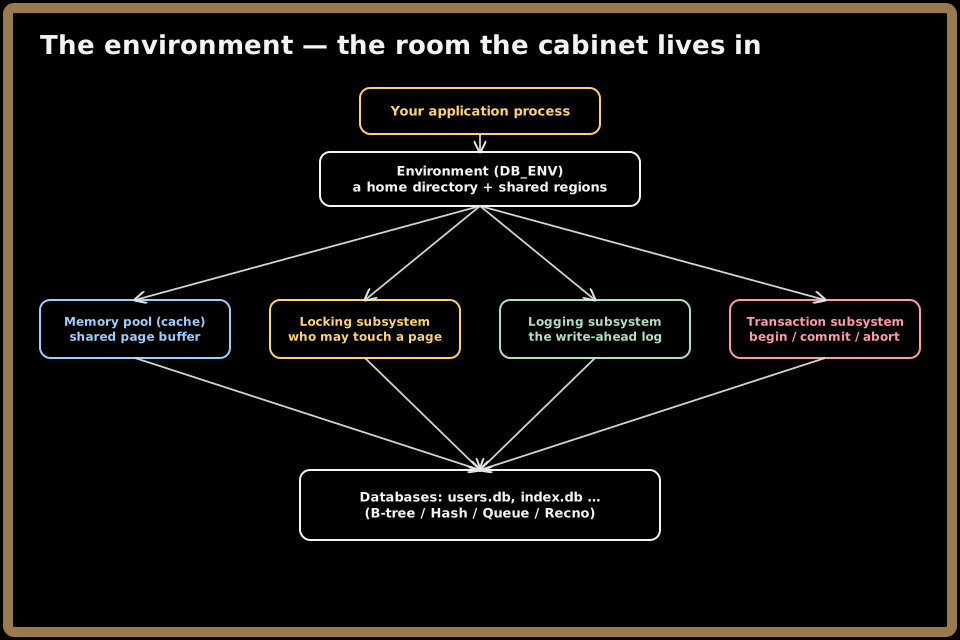
- Memory pool (Mpool) — the shared page cache. Database files are read and written in fixed-size pages; hot pages live here so most operations never touch disk. (The caching chapter's logic applies directly.)
- Locking — coordinates concurrent access so two threads don't corrupt a page; the basis for isolation.
- Logging — the write-ahead log (WAL), the durable journal that makes crash recovery possible. This is the star of Part 2 (and there's a dedicated Write-Ahead Log topic in this tier).
- Transactions — ties it all together into ACID units of work you can
commitorabort.
You choose how much of this machinery you want, which gives BDB three "product" personalities:
- DS (Data Store): raw single-writer storage, no locking, no transactions — just the cabinet.
- CDS (Concurrent Data Store): many readers + one writer, with simple locking but no transactions.
- TDS (Transactional Data Store): the full ACID engine — locking + logging + transactions + recovery. This is the interesting one, and what we mean from here on.
Quick check before moving on:
3. How you actually use it
Here's the whole shape of a transactional program — open an environment, open a B-tree inside it, and do a durable put. Illustrative C-style pseudocode (BDB has bindings for C++, Java, Python, and more):
// 1. Open the environment: the "office" holding cache + locks + log + txns.
//    DB_RECOVER runs crash recovery on startup — always safe to include.
DB_ENV *env;  db_env_create(&env, 0);
env->open(env, "/var/lib/myapp/bdb",
          DB_CREATE | DB_INIT_MPOOL | DB_INIT_LOG |
          DB_INIT_LOCK | DB_INIT_TXN | DB_RECOVER, 0);

// 2. Open a B-tree database inside that environment.
DB *db;  db_create(&db, env, 0);
db->open(db, NULL, "users.db", NULL, DB_BTREE, DB_CREATE, 0);

// 3. A transactional write. key and value are just byte strings (DBT).
DB_TXN *txn;  env->txn_begin(env, NULL, &txn, 0);
DBT key = { .data = "alice",        .size = 5  };
DBT val = { .data = "{...json...}", .size = 12 };
db->put(db, txn, &key, &val, 0);
txn->commit(txn, 0);   // by default, fsyncs the log → durable before this returns
Reading back is symmetric — db->get(db, txn, &key, &result, 0) — and to scan a range in a B-tree you open a cursor and walk it (c->get(..., DB_NEXT)), which returns keys in sorted order. Notice what's absent: no connection string, no SQL, no server to start. The database is a file (users.db) inside a directory, and your process opens it directly.
⚠️ Because BDB lives inside your process, a bug in your program can, in principle, scribble on its memory — there's no server boundary protecting the data from you. And multiple processes sharing one environment must cooperate carefully (matching flags, one recovery owner on startup). The flip side of "no clerk down the hall" is "no clerk enforcing the rules, either."
4. When to reach for it — and when not
Reach for Berkeley DB when:
- You're building a single-node application that needs fast, durable, transactional local storage and you don't want to operate a separate database server. Think a mail server's alias map, an LDAP backend, a package manager's index, a desktop app's wallet or metadata store.
- You need a storage engine to build on — a raw ordered/unordered KV map with ACID and recovery — under your own higher-level system (BDB has historically sat under SQL layers, LDAP servers, and message queues).
- Embedding matters: you want zero external dependencies, a tiny footprint (the library is on the order of a megabyte), and no network hop on the hot path.
Reach for something else when:
| You need… | Better fit |
|---|---|
| Ad-hoc queries, joins, secondary indexes, SQL | PostgreSQL / SQLite (SQLite is the other giant of embedded, but SQL-first) |
| Write-optimized, high-ingest KV on SSDs (LSM) | RocksDB / LevelDB (its LSM-based successors) |
| Horizontal scale across many machines, always-on writes | Cassandra / DynamoDB (masterless, distributed) |
| An in-memory cache / data-structure server over the network | Redis |
The honest summary: BDB is a single-machine embedded engine. It replicates for read-scaling and failover (Part 2), but it does not shard your data across a cluster the way Cassandra does. Its lane is "a real ACID database, compiled into one program, on one node."
5. Key takeaways
- Berkeley DB is an embedded, in-process key/value library — a filing cabinet built into your program, not a server you call. No network hop, no SQL by default; keys and values are opaque byte strings you serialize yourself.
- It exists to fill the gap between "hand-roll your own file format" and "run a whole SQL server" — giving you B-trees, a page cache, ACID transactions, and crash recovery as linkable code. That's why it's quietly embedded inside LDAP servers, mail systems, SCM tools, and crypto wallets.
- The access method decides which queries are cheap: B-tree (sorted, range-friendly, the default), Hash (exact-match at huge scale), Queue/Recno (record-number access). Pick B-tree unless you have a specific reason.
- The environment bundles four subsystems — cache (Mpool), locking, logging (WAL), transactions — and you dial in how much you need via DS / CDS / TDS (raw / concurrent / fully transactional).
- Use it for single-node durable local storage and as a storage engine to build on; reach for SQL databases, RocksDB, or Cassandra when you need queries, write-optimized ingest, or multi-node scale.
Test yourself on this part's key ideas:
Next, Part 2 opens the cabinet and looks at the machinery: the B-tree pages, the write-ahead log that makes a committed transaction survive a crash, how recovery replays that log, and how single-master replication ships the log to a branch office.