Math and Game
What is this?
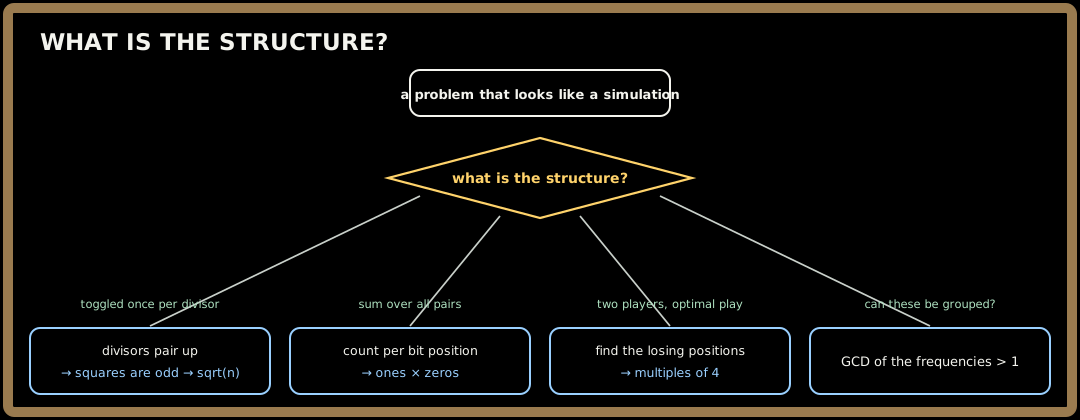
A hundred bulbs, a hundred rounds of toggling, and the question is how many end up on. You could simulate it — O(n²) toggles. Or you could notice that bulb k is flipped once for each of its divisors, that divisors come in pairs, and that only a perfect square has an unpaired one. The answer is floor(sqrt(n)), and the simulation was never needed.
Every problem here is that shape. The work is finding the structural fact, and once you have it there is almost no code.
💡 Fun fact: Nim Game with the "take 1 to 3 stones" rule is decided entirely by
n % 4. If the pile is a multiple of four you lose against perfect play, because whatever you take (1, 2 or 3), your opponent takes the complement (3, 2 or 1) and restores a multiple of four — shrinking the pile by exactly four each round until you face zero. The whole solution isreturn n % 4 != 0, and the reasoning takes longer to say than the code takes to write.
🔓 The 7 problems in this chapter are free. Sign in with Google or Microsoft to start solving.
The one-line idea: work out what the answer must be from the structure — how many times something is toggled, how each bit position contributes, which positions are lost regardless of play — instead of simulating the process described.
1. Counting per position instead of per pair
Total Hamming Distance sums the bit differences over every pair of numbers. With n up to 10⁴ that is 50 million pairs, and the problem is not asking you to enumerate them.
Look at one bit position in isolation. If k of the n numbers have a 1 there, then every one of those k differs from each of the n − k numbers with a 0 — contributing k × (n − k) to the total. Bits are independent, so:
total = 0
for bit in range(32):
    ones = sum((x >> bit) & 1 for x in nums)
    total += ones * (len(nums) - ones)
return total
O(32n) instead of O(n²), and the decomposition — each position contributes independently — is the transferable idea, not the code.
2. Losing positions
For a two-player game with optimal play, work out which positions lose. With stones and moves of 1–3, position 0 is a loss for whoever must move. Positions 1, 2 and 3 are wins (take everything). Position 4 is a loss, because every move leaves the opponent a winning position. The pattern repeats every four.
3. Grouping by a common divisor
X of a Kind in a Deck of Cards asks whether the cards can be split into equal groups of size at least 2. Count each value's frequency; a valid group size must divide every frequency, so the question is whether the GCD of all the frequencies is at least 2.
4. A 30-second worked example (Total Hamming Distance)
nums = [4, 14, 2] → binary 00100, 01110, 00010
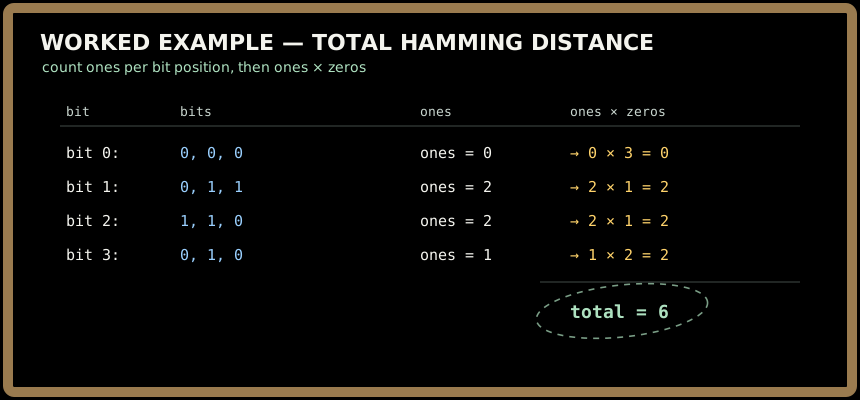
Check by brute force: d(4,14) = 2, d(4,2) = 2, d(14,2) = 2 → 6 ✓. The per-bit sum agrees, and it never looked at a pair.
5. Where you'll actually meet this
- Bit-level analytics. Population counts and pairwise-difference totals over large datasets are computed per position, never per pair.
- Error-correcting codes. Hamming distance is the foundational metric for code design.
- Game AI. Losing-position analysis decides optimal play in combinatorial games.
- Inventory and packing. GCD-based grouping determines whether items divide evenly into equal batches.
- Layout. Finding the most square rectangle for a given area is a real UI and packing problem.
6. Problems in this chapter
▶ Bulb Switcher
How many bulbs remain on after n rounds of toggling. Divisors pair except for perfect squares, so the answer is floor(sqrt(n)).
Pattern: divisor parity. Target: O(1) time.
▶ Total Hamming Distance
Sum of bit differences over all pairs. Count ones per bit position and add ones × zeros.
Pattern: per-position decomposition. Target: O(32n) time, O(1) space.
▶ Nim Game
Can the first player win taking 1–3 stones? Lose exactly when the count is a multiple of four.
Pattern: losing-position invariant. Target: O(1) time.
▶ X of a Kind in a Deck of Cards
Can the deck be split into equal groups of at least two? Take the GCD of all value frequencies.
Pattern: GCD over frequencies. Target: O(n) time.
▶ Can Make Arithmetic Progression From Sequence
Can the values be reordered into an arithmetic progression? Sort and check that consecutive differences are equal.
Pattern: sort then verify. Target: O(n log n) time.
▶ Construct the Rectangle
Most square L × W with L · W = area and L >= W. Walk W down from floor(sqrt(area)) to the first divisor.
Pattern: divisor search from the square root. Target: O(sqrt(area)) time.
7. Common pitfalls 🚫
- Simulating the bulbs.
O(n²)when the answer is a square root. - Enumerating pairs for Hamming distance. The per-bit decomposition exists exactly to avoid it.
- Fixing the bit width at 32 without checking. Fine for the stated constraints, but say so.
- Starting the rectangle search at 1. Start at
floor(sqrt(area))and walk down; the first divisor found is the most square. - Forgetting the group size must be at least 2 in the card problem — a GCD of 1 means impossible.
- Sorting is not optional for the arithmetic-progression check; the input is explicitly unordered.
- Assuming the Nim rule. The multiple-of-four result depends on the "1 to 3" move set; a different move set gives a different invariant.
- Mirror Reflection — which corner a light ray reaches in a mirrored square. Instead of simulating bounces, unfold the reflections into a straight line: the answer is decided by the parities of
pandqafter dividing out their common factor.
8. Key takeaways
- Reason to the answer. Ask what it must be before deciding how to compute it.
- Divisors pair, so squares are the exception — the observation behind an entire family of puzzles.
- Decompose into independent positions and a quadratic count becomes linear.
- Games are decided by losing positions, found by working up from zero.
- A GCD answers "can these be grouped evenly?"
- Search divisors from the square root when you want the most balanced factor pair.
- Why interviewers use these: they cannot be pattern-matched, so they reveal whether you probe a problem's structure or reach for a data structure by reflex.
Order: Bulb Switcher → Total Hamming Distance → Nim Game → X of a Kind in a Deck of Cards → Can Make Arithmetic Progression From Sequence → Construct the Rectangle → Mirror Reflection.
Can Make Arithmetic Progression From Sequence
Core idea: A set of numbers can be rearranged into an arithmetic progression iff, once sorted, every adjacent gap is identical. You don't have to try orderings — the only candidate ordering is the sorted one, so sort and verify one constant gap. And you don't even have to sort: in an AP the gap is forced to be
(max − min) / (n − 1), so you can compute that gap once and check that every value lands on the progression.
Problem, rephrased
You're checking a voltage ladder that is supposed to produce evenly spaced levels, but the measurements reach you in no particular order. You're given an integer array arr, where arr[i] is one measured level in millivolts — values may be negative, since the ladder spans both polarities.
Return true if the levels can be rearranged into an arithmetic progression — a sequence in which the difference between every pair of consecutive elements is the same constant — and false otherwise. Measurement order carries no information, so any rearrangement is allowed, and the array always holds at least two values, so there is always at least one gap to check.
Strip the story away and this is Can Make Arithmetic Progression From Sequence (LeetCode 1502): given an array of integers arr, return true if the elements can be rearranged to form an arithmetic progression, and false otherwise.
Input / output
| Input (any order) | Output | Why |
|---|---|---|
[3,5,1] |
true |
Sorts to [1,3,5]; gaps 2,2. |
[1,2,4] |
false |
Sorts to [1,2,4]; gaps 1,2 differ. |
[1,2] |
true |
Two elements — a single gap, trivially constant. |
[5,5,5,5] |
true |
Sorts to [5,5,5,5]; gap is 0 throughout. |
[0,-2,-4,-6] |
true |
Sorts to [-6,-4,-2,0]; gap 2. Negative values and a positive gap are fine. |
Sign in to continue reading
The rest of this lesson is available with a free account. Signing in with Google or Microsoft is free.
Sign in to read the full lesson