Simulation and Parsing
What is this?
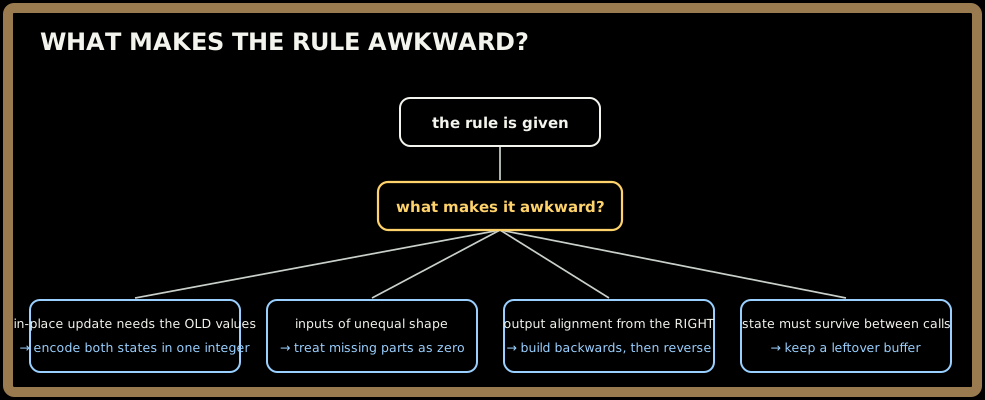
There is nothing to discover in these problems. The rules are printed in the question, and the entire task is implementing them exactly — which turns out to be harder than it sounds, because each one contains a case that is easy to overlook and produces an answer that is almost right.
Version 1.0 versus 1.0.0. A snapshot update where a cell must not see its neighbour's new value. A read that must remember characters left over from last time. In every case, enumerating the cases before writing is what separates a clean answer from a patched one.
💡 Fun fact: Read N Characters Given Read4 II is the version with multiple calls, and it is a genuinely different problem from the single-call one.
read4always fetches four characters, so a call asking for 5 will over-read by 3 — and those 3 characters belong to the next call. The buffer holding them must therefore live in the object, not the function. Anyone who has written a network or file reader has met this exact bug, which is why the problem is asked at all.
🔓 The 5 problems in this chapter are free. Sign in with Google or Microsoft to start solving.
The one-line idea: find the awkward part of the specification and choose a representation that dissolves it — two bits per cell for a simultaneous update, implicit zeros for missing segments, a persistent buffer for leftover input.
1. Encode two states in one value
Game of Life updates every cell simultaneously, so a cell must see its neighbours' old values. Rather than copying the grid, keep the old state in bit 0 and write the new state into bit 1:
for r in range(m):
    for c in range(n):
        live = count_live_neighbours(board, r, c)      # reads bit 0 only
        if board[r][c] & 1:                            # currently alive
            if live in (2, 3):
                board[r][c] |= 2                       # stays alive
        elif live == 3:
            board[r][c] |= 2                           # becomes alive

for r in range(m):
    for c in range(n):
        board[r][c] >>= 1                              # new state becomes current
Counting neighbours with & 1 always reads the old value, whether or not that neighbour has been processed. The second pass is a shift. No second grid, and the rule stays readable.
2. Missing means zero
def compare_version(v1, v2):
    a, b = v1.split('.'), v2.split('.')
    for i in range(max(len(a), len(b))):
        x = int(a[i]) if i < len(a) else 0             # missing segment = 0
        y = int(b[i]) if i < len(b) else 0
        if x != y:
            return 1 if x > y else -1
    return 0
Iterating to the longer length and defaulting to zero is what makes 1.0 equal 1.0.0. And int() handles leading zeros for free, which is why comparing the strings directly would be wrong.
3. Build backwards when alignment is from the right
Licence key reformatting groups characters from the end, so the first group may be short. Building the result in reverse and reversing at the end avoids computing where the short group starts:
cleaned = s.replace('-', '').upper()
out = []
for i, ch in enumerate(reversed(cleaned)):
    if i and i % k == 0:
        out.append('-')
    out.append(ch)
return ''.join(reversed(out))
4. A 30-second worked example (Buddy Strings)
Can s become goal with exactly one swap?
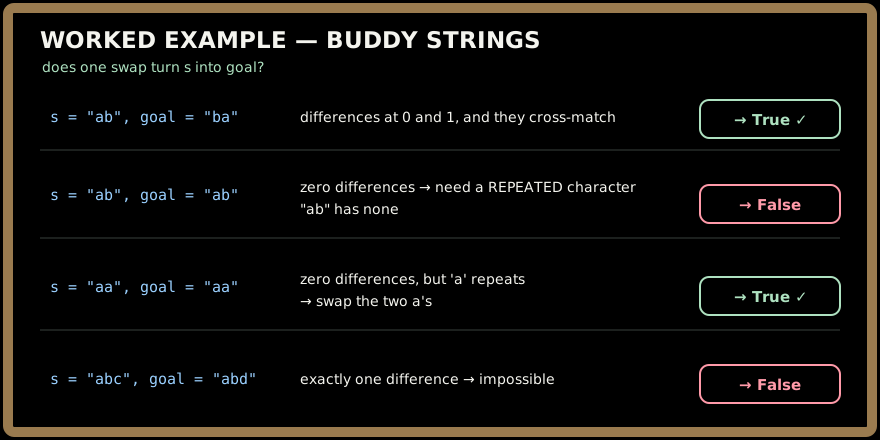
The third case is the one that catches people. Equal strings are only buddies if some character appears twice, because the swap must actually happen and must leave the string unchanged.
5. Where you'll actually meet this
- Release and dependency tooling. Semantic version comparison with unequal segment counts, in every package manager.
- Payment and identifier display. Right-aligned grouping of card numbers, licence keys and IBANs.
- Cellular automata and simulation. Any simultaneous-update rule on a grid, from Conway to physics steps.
- I/O and network layers. Buffered reads where a fixed-size fetch over-reads and the remainder must persist.
- Diff and comparison tools. Character-level difference detection with precise case handling.
6. Problems in this chapter
▶ Game of Life
Update a grid in place under simultaneous-update rules. Two bits per cell, then a shift pass.
Pattern: in-place state encoding. Target: O(mn) time, O(1) extra space.
▶ Compare Version Numbers
Compare dotted version strings. Split, iterate to the longer length, treat missing segments as zero.
Pattern: defensive parsing. Target: O(n) time.
▶ License Key Formatting
Regroup a key into blocks of k from the right, uppercased. Build backwards and reverse.
Pattern: right-aligned grouping. Target: O(n) time.
▶ Buddy Strings
Decide whether one swap makes the strings equal. Enumerate: unequal lengths, zero differences with a repeat, exactly two cross-matching differences.
Pattern: exhaustive case analysis. Target: O(n) time, O(1) space.
▶ Read N Characters Given Read4 II
Read n characters using a read4 primitive, across multiple calls. Keep the over-read characters in a persistent buffer.
Pattern: buffered I/O with retained state. Target: O(n) per call.
7. Common pitfalls 🚫
- Copying the grid in Game of Life. Correct, and it fails the stated in-place requirement.
- Reading neighbours without masking.
& 1is what keeps the count reading pre-update values. - Comparing version strings lexicographically.
"10" < "9"as text; parse to integers. - Iterating only to the shorter version's length.
1.0and1.0.0must compare equal. - Forgetting the repeated-character case in Buddy Strings when the strings are already equal.
- Making the leftover buffer local in the read problem. It must persist across calls, which is the entire point of part II.
- Assuming
read4fills the buffer. A short read means end of file, and the loop must stop.
8. Key takeaways
- Find the awkward clause and design around it. Simultaneous updates, unequal lengths, retained state.
- Two bits per cell turn an in-place simultaneous update into two clean passes.
- Missing means zero, not shorter-therefore-smaller.
- Build backwards when alignment is from the right, then reverse once.
- State that must survive calls belongs to the object, not the function.
- Enumerate cases before coding. On Buddy Strings that list is the solution.
- Why interviewers use these: no insight can rescue a sloppy implementation, so they show your actual habits — which is precisely what they want to see.
Order: Game of Life → Compare Version Numbers → License Key Formatting → Buddy Strings → Read N Characters Given Read4 II.
Compare Version Numbers
Core idea: A version string like
1.01.3is not one number — it's a list of revisions separated by dots:[1, 1, 3]. Compare two versions the way you'd compare those lists: split each on., turn every chunk into an integer (so01and1are the same, and trailing.0s vanish), then walk the two lists position by position. The first position where the integers differ decides the winner. If one list runs out first, treat its missing revisions as0. Return-1,0, or1.
Problem, rephrased
A package manager has to decide whether an installed dependency satisfies a manifest — is installed 2.3.10 at least the required 2.3.9? — so it needs a total order on version strings. You're given two version strings, version1 and version2; each is a sequence of revisions joined by dots (.), and each revision is a string of digits that may carry leading zeros.
Return -1 if version1 < version2, 1 if version1 > version2, and 0 if they're equal. Compare the i-th revisions as integers, left to right — so 1.01 and 1.001 are equal (01 == 001 == 1) — with the first differing position deciding the order; if one version has fewer revisions, treat the missing ones as 0, because a release that never specified a patch number sorts as patch zero (so 1.0 and 1.0.0 are equal).
Strip the story away and this is the classic Compare Version Numbers task: given version1 and version2, return -1, 0, or 1 per revision-by-revision integer comparison, zero-padding the shorter version.
A worked input/output
| version1 | version2 | Output | Why |
|---|---|---|---|
"1.2" |
"1.10" |
-1 | First revisions tie (1==1); then 2 < 10. Lexically "2" > "10" — that's the trap. |
"1.01" |
"1.001" |
0 | Integer revisions [1,1] vs [1,1] — leading zeros don't matter. |
"1.0" |
"1.0.0" |
0 | [1,0] vs [1,0,0]; the missing third revision counts as 0. |
"0.1" |
"1.1" |
-1 | First revisions decide it immediately: 0 < 1. |
Notice the answer depends only on the integer value of each revision and on position, never on how many digits were typed.
Sign in to continue reading
The rest of this lesson is available with a free account. Signing in with Google or Microsoft is free.
Sign in to read the full lesson