Number and Math
What is this?
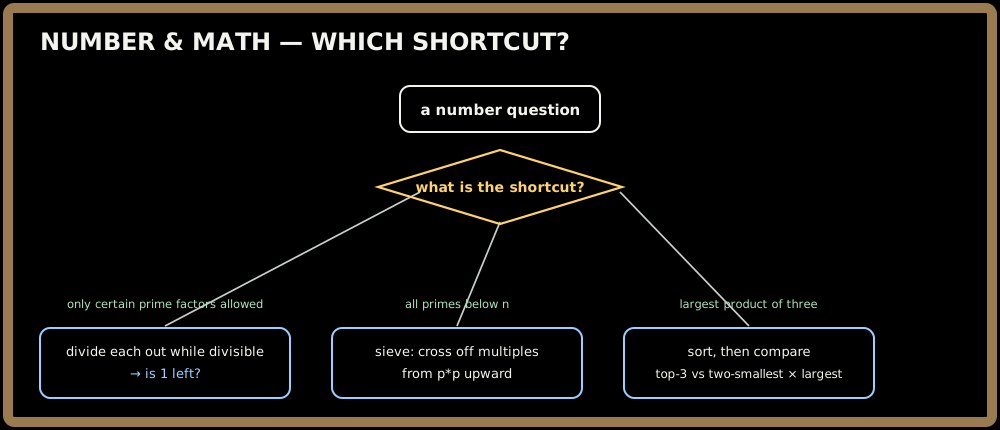
Three problems that each have an obvious slow solution and a short correct one. Testing every number up to n for primality is quadratic-ish; crossing off multiples is nearly linear. Checking every triple for the largest product is cubic; sorting once makes it two comparisons. Testing whether a number's only prime factors are 2, 3 and 5 by factorising it fully is unnecessary; dividing those factors out and checking what is left is three loops.
The pattern is the same each time: stop asking about every candidate and start eliminating whole classes at once.
💡 Fun fact: the Sieve of Eratosthenes is around 2,200 years old and still the practical way to list primes below a few million. Two refinements make it fast: start crossing off at
p × p— every smaller multiple ofpalready has a smaller prime factor and was struck out earlier — and stop the outer loop at√n, because any composite belownhas a factor no larger than that. Those two details take it fromO(n log n)-ish toO(n log log n).
🔓 The 4 problems in this chapter are free. Sign in with Google or Microsoft to start solving.
The one-line idea: eliminate classes rather than testing individuals — divide known factors out, cross off multiples in bulk, or sort so that only two candidate answers remain to compare.
1. Divide the factors out
def is_ugly(n):
    if n <= 0:
        return False
    for p in (2, 3, 5):
        while n % p == 0:
            n //= p
    return n == 1
If dividing away every 2, 3 and 5 leaves exactly 1, the number had no other prime factors. The n <= 0 guard matters: zero would loop forever and negatives are excluded by definition.
2. Sieve, do not test
def count_primes(n):
    if n < 3:
        return 0
    is_prime = [True] * n
    is_prime[0] = is_prime[1] = False
    p = 2
    while p * p < n:
        if is_prime[p]:
            for multiple in range(p * p, n, p):     # start at p*p, not 2p
                is_prime[multiple] = False
        p += 1
    return sum(is_prime)
Starting at p × p is not a micro-optimisation — every multiple k × p with k < p has a prime factor smaller than p and was already crossed off when that smaller prime was processed.
3. Enumerate the sign cases
The largest product of three numbers is one of exactly two candidates:
- the three largest values, or
- the two most negative values times the largest.
The second wins when two large negatives multiply into a large positive. Sorting makes both readable in one line:
nums.sort()
return max(nums[-1] * nums[-2] * nums[-3],
           nums[0] * nums[1] * nums[-1])
There is a linear alternative that tracks the three largest and two smallest in one pass — worth mentioning as the O(n) improvement once the sorted version is on the board.
4. A 30-second worked example
nums = [-10, -10, 1, 3, 2]
sorted: [-10, -10, 1, 2, 3]

candidate A — three largest:      1 x 2 x 3       = 6
candidate B — two smallest x max: -10 x -10 x 3   = 300  ✅

answer = 300
Taking only the three largest gives 6 and is wrong. The two negatives cancel, which is exactly the case the second candidate exists to catch.
5. Where you'll actually meet this
- Cryptography and hashing. Prime generation underpins key selection and table sizing.
- Numeric libraries. Smooth-number tests (only small prime factors) decide whether a fast Fourier transform size is efficient.
- Financial and scoring calculations. Extreme-product selections where negative values are meaningful.
- Load and shard sizing. Choosing sizes with convenient factorisations.
- Competitive and simulation code. Precomputed prime tables are a standard warm-up step.
6. Problems in this chapter
▶ Ugly Number
Decide whether a number's only prime factors are 2, 3 and 5. Divide each out repeatedly and check that 1 remains.
Pattern: factor elimination. Target: O(log n) time, O(1) space.
▶ Count Primes
Count primes below n. Sieve of Eratosthenes, crossing off from p × p with the outer loop bounded by √n.
Pattern: sieve. Target: O(n log log n) time, O(n) space.
▶ Maximum Product of Three Numbers
Largest product of any three values. Sort, then take the better of the top three and the two smallest times the largest.
Pattern: sign-case enumeration. Target: O(n log n) sorted, or O(n) with a single tracking pass.
7. Common pitfalls 🚫
- Looping forever on zero in the factor test. Guard
n <= 0first. - Starting the sieve at
2p. Correct but slower;p × pis the right lower bound. - Running the outer sieve loop to
n. It only needs to reach√n. - Off-by-one on "below n". Count Primes excludes
nitself, so the array hasnentries indexed0..n-1. - Taking only the three largest for the product. Two negatives can beat them.
- Assuming at least one positive value exists. An all-negative array still has a well-defined answer.
- Overflow. Three values near 10³ are fine, but in fixed-width languages the general case needs a 64-bit type.
- Day of the Week — the weekday for a given date. Either count days since a known anchor or apply Zeller's congruence; the leap-year rule (divisible by 4, except centuries, unless divisible by 400) is the part that must be exactly right.
8. Key takeaways
- Eliminate classes, not individuals. Cross off multiples; divide out factors.
p × pand√nare the two details that make a sieve fast.- Two candidates decide the extreme product, and the negative case is the one that gets missed.
- Sort for clarity, then offer the linear version — showing both is stronger than either alone.
- Guard the degenerate inputs. Zero, negatives and tiny
nare where these fail. - Know the standard complexities.
O(n log log n)for a sieve is worth saying precisely. - Why interviewers like it: short problems with well-known optimal solutions, so they reveal quickly whether you know the standard tools or are improvising.
Order: Ugly Number → Count Primes → Maximum Product of Three Numbers → Day of the Week.
Core idea: Instead of testing each number for primality on its own, flip the question around — start with every number assumed prime, then walk through the small primes and cross out their multiples. Whatever survives the crossing-out is prime, and because each composite is struck by its smallest prime factor, the total work collapses to a near-linear O(n log log n).
Problem, rephrased
You're building the key-generation path of a crypto library: before hunting for large random primes, it precomputes a table of every small prime so candidates divisible by 2, 3, 5, 7, … can be rejected cheaply. You're given a single integer n — the exclusive upper bound of that table's range.
Return the count of prime numbers strictly less than n. A prime is a whole number greater than 1 whose only divisors are 1 and itself — 2, 3, 5, 7, 11, … — and strictly matters: for n = 10 you count primes in 2..9, never including 10 itself. The library rebuilds this table for bounds n in the millions, so testing each candidate independently by trial division is too slow — the whole range has to be handled at once.
Strip the story away and this is the classic Count Primes: given an integer n, return the number of primes p with p < n.
| Input | Output | Why |
|---|---|---|
n = 10 |
4 |
primes below 10 are 2, 3, 5, 7 |
n = 0 |
0 |
no numbers below 0 to consider |
n = 1 |
0 |
nothing below 1 is prime |
n = 2 |
0 |
the smallest prime is 2, but we need strictly less than 2 |
Sign in to continue reading
The rest of this lesson is available with a free account. Signing in with Google or Microsoft is free.
Sign in to read the full lesson