String Processing
What is this?
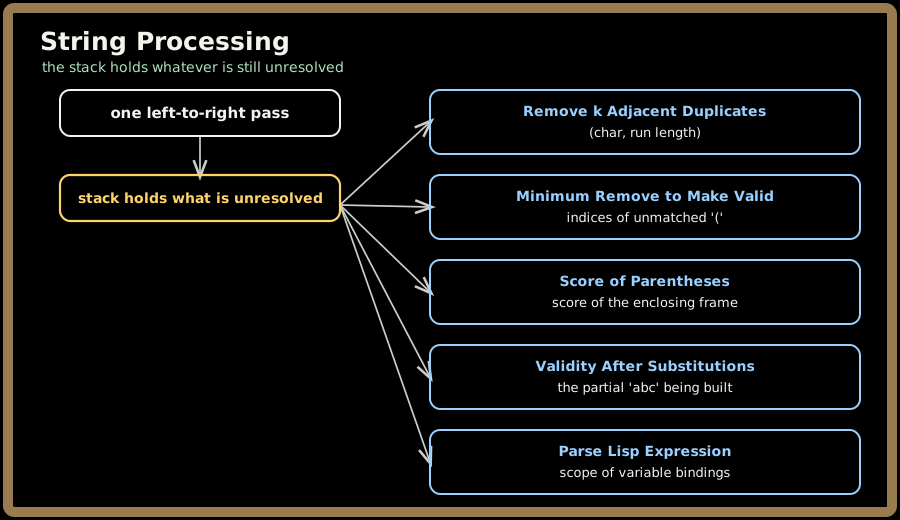
Every problem here is a single left-to-right pass where the stack holds what is still open, or still liable to be cancelled. Adjacent duplicates cancel; unmatched brackets are removed; nested groups score; a Lisp expression's scopes stack up and unwind. In each case you never look backwards through the string — whatever needs revisiting is already sitting on the stack, in the right order.
💡 Fun fact: Score of Parentheses has a solution so short it looks wrong: track the current depth, and every time you see
()add2^depthto the answer. No stack at all. It works because scoring is distributive — the nesting multiplies each innermost pair by a power of two, and summing those contributions independently gives the same total. That is the same "count each atom's contribution" move as the monotonic-stack chapter, and it is worth recognising the family resemblance.
🔓 The 5 problems in this chapter are free. Sign in with Google or Microsoft to start solving.
The one-line idea: push what is unresolved, pop when it resolves, and the stack's contents at the end are the answer — the survivors, the unmatched positions, or the accumulated score.
1. Push the pair, not the character
Removing k adjacent duplicates naively means re-scanning after each removal, which is quadratic. Push (character, run length) instead:
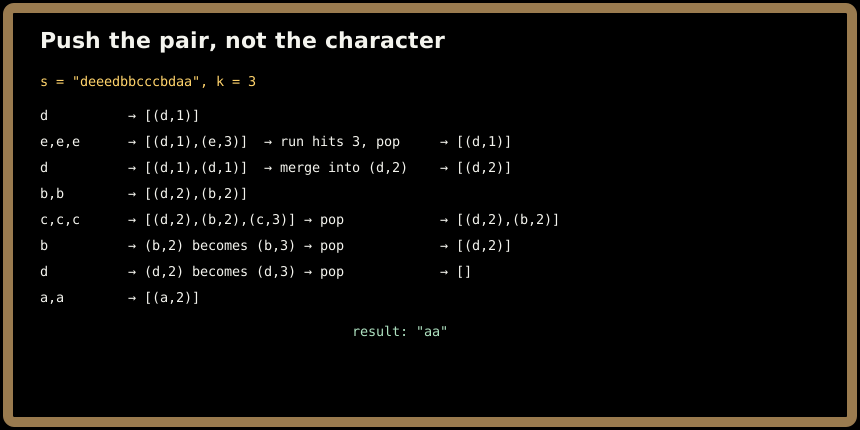
The cascade is the point. Removing ccc brings a b next to bb, which removes and brings a d next to dd. Counting on the stack makes each cascade automatic rather than requiring another pass.
2. The stack as a record of what to delete
Minimum Remove to Make Valid Parentheses does not build the answer on the stack — it collects indices to remove. Push the index of every (; on a ), pop if the stack is non-empty, otherwise mark this ) as unmatched. Whatever indices remain on the stack at the end are unmatched (. Delete both sets in one final pass.
This inversion — using the stack to record failures rather than successes — is worth having in your repertoire.
3. Scopes and bindings
Parse Lisp Expression is the hardest problem in the chapter, and the stack holds scopes. A let introduces bindings that shadow outer ones and must disappear when its expression closes. The clean structure is a stack of dictionaries: look up a variable by scanning from the innermost scope outward, and pop the whole frame when the expression ends. That is exactly how a real interpreter handles lexical scope.
4. Where you'll actually meet this
- Editors and IDEs. Bracket matching, auto-close, and "highlight the unmatched paren" are this exact scan.
- Linters and formatters. Detecting and repairing unbalanced delimiters, and computing nesting depth for indentation.
- Interpreters. Scope chains for variable lookup are a stack of dictionaries, precisely as above.
- Text sanitisation. Collapsing repeated characters and stripping malformed markup before rendering user content.
- Protocol and log parsing. Nested framing formats unwind with the same push/pop discipline.
5. Problems in this chapter
▶ Score of Parentheses
Score a balanced string where () is 1, AB is A+B, and (A) is 2*A. Either stack the enclosing frame's score, or use the depth trick and sum 2^depth per innermost pair.
Pattern: stack of frame scores (or depth contribution). Target: O(n) time, O(n) or O(1) space.
▶ Minimum Remove to Make Valid Parentheses
Remove the fewest characters to balance the string. Stack the indices of unmatched (, mark unmatched ) as you go, delete both sets at the end.
Pattern: stack of failure positions. Target: O(n) time, O(n) space.
▶ Remove All Adjacent Duplicates in String II
Delete every run of exactly k equal adjacent characters, repeatedly. Push (char, count) so cascades resolve in one pass.
Pattern: stack of (value, run length). Target: O(n) time, O(n) space.
▶ Check If Word Is Valid After Substitutions
Decide whether a string can be built by repeatedly inserting "abc". Push characters and pop a completed abc whenever a c closes one.
Pattern: stack as a partial-match buffer. Target: O(n) time, O(n) space.
▶ Parse Lisp Expression
Evaluate a small Lisp with let, add and mult. A stack of scopes handles shadowing and cleanup.
Pattern: scope stack + recursive evaluation. Target: O(n) time, O(depth) space.
6. Common pitfalls 🚫
- Rescanning after each removal. Cascades must be handled by the stack, not by looping until the string stops changing — that is O(n²) at best.
- Storing characters without counts. Runs need lengths; a character-only stack forces re-counting.
- Building the result string inside the loop. Collect on the stack and join once at the end.
- Deleting by index while iterating. Collect the indices, then build the survivors in a single pass — mutating the string as you go invalidates every later index.
- Forgetting leftover unmatched
(. They are still on the stack when the scan ends and must be removed too. - Assuming
2^depthis safe for arbitrary input. For Score of Parentheses the depth is bounded by the problem, but say so rather than leaving it implicit. - Letting
letbindings leak. In the Lisp evaluator, a scope must be popped when its expression ends, or an inner binding silently shadows outward.
7. Key takeaways
- One pass, and the stack holds the unresolved. Everything you might have to revisit is already at hand, in order.
- Push pairs when runs matter.
(char, count)makes cascading deletions automatic. - A stack can record what to remove, not only what to keep.
- Scopes are a stack of dictionaries — the standard way real interpreters implement lexical scope.
- Look for a distributive shortcut. When a score decomposes per atom, depth arithmetic can replace the stack entirely.
- Collect, then build. Never mutate the string mid-scan.
- Why interviewers like it: these look like string puzzles and are really tests of whether you can spot the "open until resolved" structure and handle every cascade correctly in one pass.
Order: Score of Parentheses → Minimum Remove to Make Valid Parentheses → Remove All Adjacent Duplicates in String II → Check If Word Is Valid After Substitutions → Parse Lisp Expression.
Check If Word Is Valid After Substitutions
Core idea: Treat every
"abc"like a matched pair of brackets. Walk the string with a stack; the instant the top spellsa, b, c, cancel all three. If the stack ends empty, the string is exactly a nest of completed"abc"insertions — valid.
Problem, rephrased
A tiny templating engine builds strings one way only: starting from the empty string, it repeatedly stamps the literal "abc" anywhere into the text it has so far — at the start, at the end, or wedged inside an earlier stamp. You're given a finished string s consisting only of the letters 'a', 'b', and 'c'.
Return True if s could have been produced by that stamping process, and False otherwise. Equivalently, s is valid exactly when it can be reduced to "" by repeatedly deleting any occurrence of the substring "abc". You don't reconstruct the build order or count the stamps — a single boolean is the whole answer.
Strip the story away and this is the classic Check If Word Is Valid After Substitutions: given a string s over the alphabet {'a','b','c'}, return whether s can be reduced to the empty string by repeatedly removing the substring "abc".
Input s |
Output | Why |
|---|---|---|
"abc" |
True |
one stamp |
"aabcbc" |
True |
stamp abc, then insert another abc after the a |
"abcabcababcc" |
True |
several nested/sequential stamps reduce cleanly |
"abccba" |
False |
no deletion order ever clears it |
"aabbcc" |
False |
letters in the right counts, wrong order — never an abc |
Sign in to continue reading
The rest of this lesson is available with a free account. Signing in with Google or Microsoft is free.
Sign in to read the full lesson