Custom Keys and Restricted Ops
What is this?
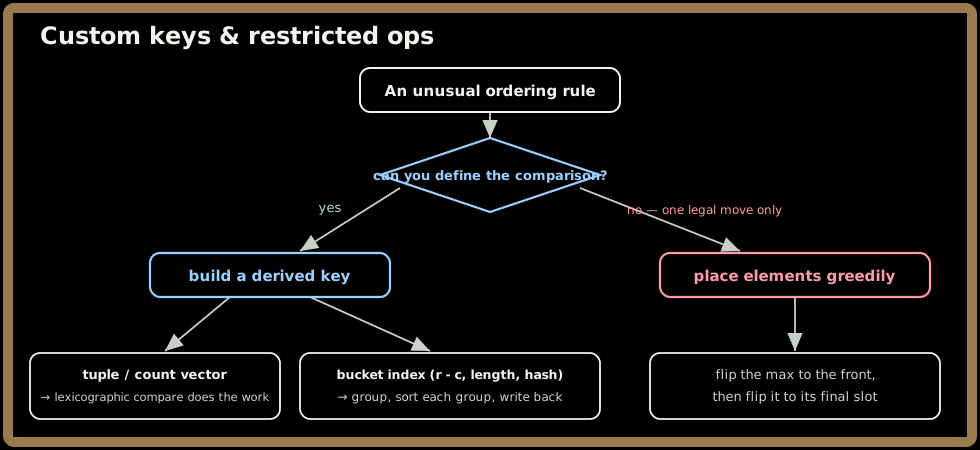
An election is being counted. Candidates are ranked by how many first-preference votes they received; ties are broken by second preferences, then third, and if two candidates are identical all the way down, alphabetically. Written as prose it sounds like a page of conditionals. Written as a key — the vector of vote counts by position, with the name on the end — it is one sort call.
The last problem in the chapter takes the opposite position: you may not define a comparison at all. The only thing you can do is flip a prefix of the stack.
💡 Fun fact: in Rank Teams by Votes the key is a vector of counts, one entry per ranking position, and comparing two vectors lexicographically reproduces the entire tie-break chain automatically. It is the same principle behind how library catalogues and dictionaries order entries: make the comparison positional, and arbitrarily deep tie-breaking costs nothing extra to express.
🔓 The 4 problems in this chapter are free. Sign in with Google or Microsoft to start solving.
The one-line idea: turn the rule into a key and let an ordinary sort apply it. When the rule cannot be turned into a key — because the only legal operation is a prefix reversal — build the order one permanently placed element at a time.
1. Count vectors as keys
For each candidate, build an array where index i holds how many voters placed them i-th:
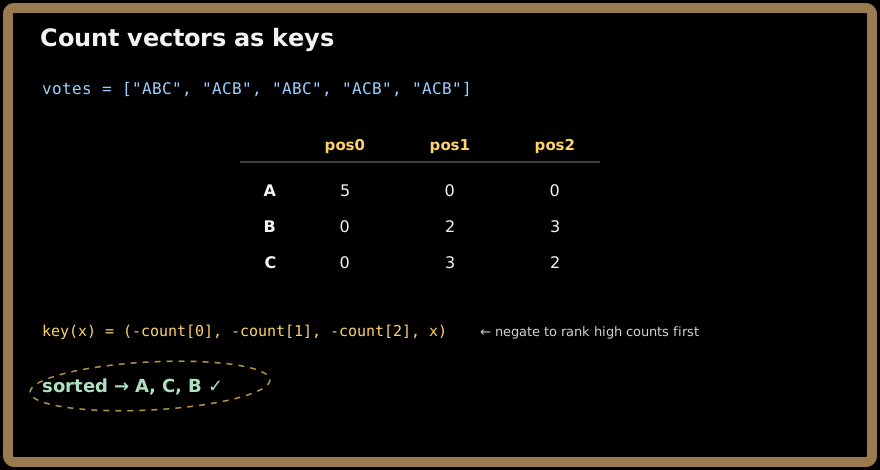
C beats B because they tie at position 0 and C has more second-place votes. The name comes last in the tuple so that identical vectors fall back to alphabetical order — and it is not negated, because alphabetical means ascending while the counts mean descending. Mixing directions inside one key is exactly what the negation trick is for; reversing the whole sort would flip the name ordering too.
2. Derived indices as buckets
Every cell on the same matrix diagonal satisfies r − c = constant. So bucket cells by that value, sort each bucket, and write them back in order:
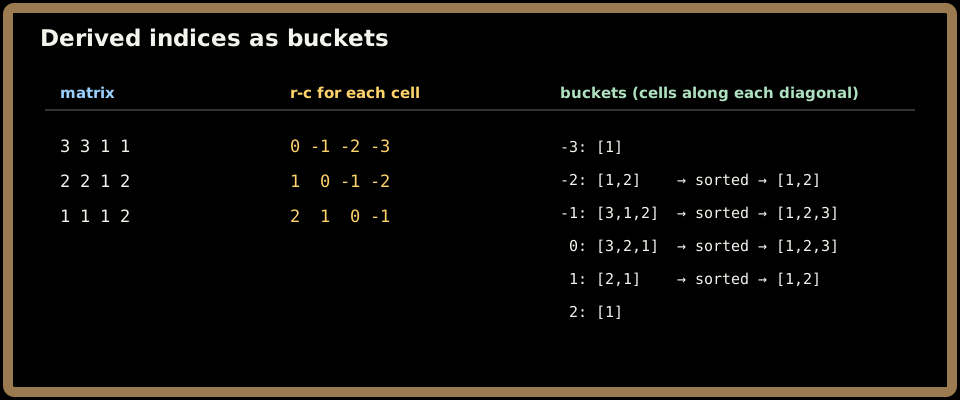
The two-dimensional problem never needed a two-dimensional algorithm — only the right index.
3. Building order with one move
Pancake sorting places the largest unplaced value each round, in two flips:
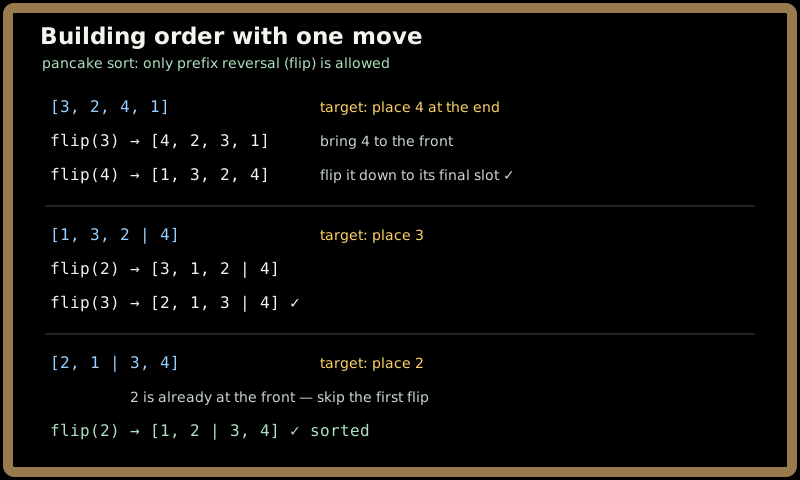
Two flips per element gives 2n operations, comfortably inside the 10n the problem allows. The invariant is that the sorted suffix never moves again — every flip is confined to the shrinking prefix.
4. Where you'll actually meet this
- Ranking and leaderboards. Multi-criteria ordering with deterministic tie-breaks, where an inconsistent comparator causes real bugs.
- Query engines.
ORDER BYwith mixed directions is the tuple key with per-component negation. - Image processing. Diagonal, anti-diagonal and band operations all bucket by a derived index.
- Version and identifier ordering. Semantic versions sort as tuples of integers, not as strings — the classic reason
1.10.0sorts before1.9.0when someone forgets. - Constrained manipulation. Robotics and genome-rearrangement problems where only a restricted operation is available.
5. Problems in this chapter
▶ Rank Teams by Votes
Rank candidates by positional vote counts with alphabetical tie-breaking. Build a count vector per candidate and sort on (-counts…, name).
Pattern: count-vector key. Target: O(n·m + m log m · m) for m candidates and n votes.
▶ Sort the Matrix Diagonally
Sort each top-left-to-bottom-right diagonal independently. Bucket cells by r − c, sort each bucket, write back.
Pattern: derived bucket index. Target: O(mn log(min(m,n))) time, O(mn) space.
▶ Pancake Sorting
Sort using only prefix reversals, within 10n flips. Place the largest unplaced value each round with at most two flips.
Pattern: greedy placement under a restricted operation. Target: at most 2n flips, O(n²) time.
6. Common pitfalls 🚫
- Reversing the whole sort instead of negating one component. That flips the alphabetical tie-break as well and produces a subtly wrong ranking.
- Comparing strings when you mean numbers. Count vectors must be numeric;
"10" < "9"lexicographically. - Forgetting the final tie-break. Two candidates with identical vectors need a deterministic order, or results vary between runs.
- Allocating a full matrix of buckets. Index by
r − coffset into a dictionary; most diagonals are short. - Flipping the already-placed suffix. Every flip must be confined to the unsorted prefix, or you undo finished work.
- Flipping when the element is already in place. Check first — the problem counts flips, and unnecessary ones can push you over the limit on the margin.
- Sorting when bucketing would do. With bounded values, counting is
O(n)and worth mentioning even if you then usesort(). - Relative Ranks — award medals by score. The key is the score paired with its original index, so sorting descending and writing back through the stored index places each label without losing where it came from.
7. Key takeaways
- Design the key and the sort becomes trivial. That design is the problem.
- Tuples express arbitrary tie-break chains, and per-component negation handles mixed directions.
- A derived index is a bucket.
r − cturns diagonals into independent one-dimensional sorts. - When comparison is unavailable, place elements permanently — one at a time, from the extreme inward.
- Protect the finished region. Restricted-operation sorts depend on never disturbing what is already placed.
- Know when not to sort. Bounded values mean counting; top-k means a heap.
- Why interviewers like it: anyone can call
sort(). Translating a messy specification into a comparator that is consistent and total is the actual skill being measured.
Order: Rank Teams by Votes → Sort the Matrix Diagonally → Pancake Sorting → Relative Ranks.
Pancake Sorting
Core idea: The only tool you have is a prefix reversal — pick a
kand reversearr[0..k-1]. To place the largest unsorted value at its final slot, first flip it to the front, then flip the whole unsorted prefix so the front element lands at the back. Two flips bury one element forever. Sort from the largest down to the smallest and you're done in at most2nflips,O(n²)time.
Problem, rephrased
A short-order cook's stack of pancakes has come off the griddle in a jumble, and the only tool on hand is a spatula: slide it in under any pancake and flip the whole chunk above it — that pancake included — over in one motion. You're given an integer array arr, a permutation of [1, 2, ..., n], where arr[i] is the size of the pancake i-th from the top; a pancake flip chooses a k and reverses the prefix arr[0..k-1], and that is the only operation allowed — no swaps, no pulling a pancake from the middle, no reversing a run that doesn't start at the top.
Sort arr into ascending order (smallest pancake on top, largest on the bottom) using pancake flips, and return the sequence of flip sizes — the list of k-values in the order applied — rather than the sorted array itself; the grader replays your flips and checks the result. Any valid sequence is accepted as long as it uses at most 10 * n flips — the two-flips-per-pancake method below stays comfortably under 2n.
Strip the story away and this is the classic Pancake Sorting (LeetCode 969): given a permutation arr of [1..n] and the single primitive "reverse the first k elements," return any list of k-values whose application sorts arr ascending, within 10 * n flips.
Input / output
Input arr |
A valid output (flip sizes) | After applying the flips |
|---|---|---|
[3, 2, 4, 1] |
[3, 4, 2, 3, 2] |
[1, 2, 3, 4] |
[1, 2, 3] |
[] |
[1, 2, 3] (already sorted) |
[4, 3, 2, 1] |
[4] |
[1, 2, 3, 4] (one flip) |
[1] |
[] |
[1] |
The output isn't unique — any flip sequence that ends in a sorted array is correct. The grader replays your flips and checks the result.
Sign in to continue reading
The rest of this lesson is available with a free account. Signing in with Google or Microsoft is free.
Sign in to read the full lesson