Keyed Stores
What is this?
A library keeps every edition of every book it has ever held. Asked for "the edition that was current in March 2019", the librarian does not read the whole shelf — the editions sit in date order, so she jumps to roughly the right place and steps back one. That works because the writes arrive in order, which is what makes the reads cheap.
Every problem here is a version of that bargain. You get to choose which operation does the work, and the choice is the answer.
💡 Fun fact: Time Based Key-Value Store is only easy because of a single line in the problem statement: timestamps arrive strictly increasing. That guarantee means each key's history is already sorted, so
setis anO(1)append andgetis anO(log n)binary search for the largest timestamp not exceeding the query. Remove that guarantee andsetneeds an insertion into a sorted structure. Noticing which stated constraint is doing the work is most of what these questions test.
🔓 The 3 problems in this chapter are free. Sign in with Google or Microsoft to start solving.
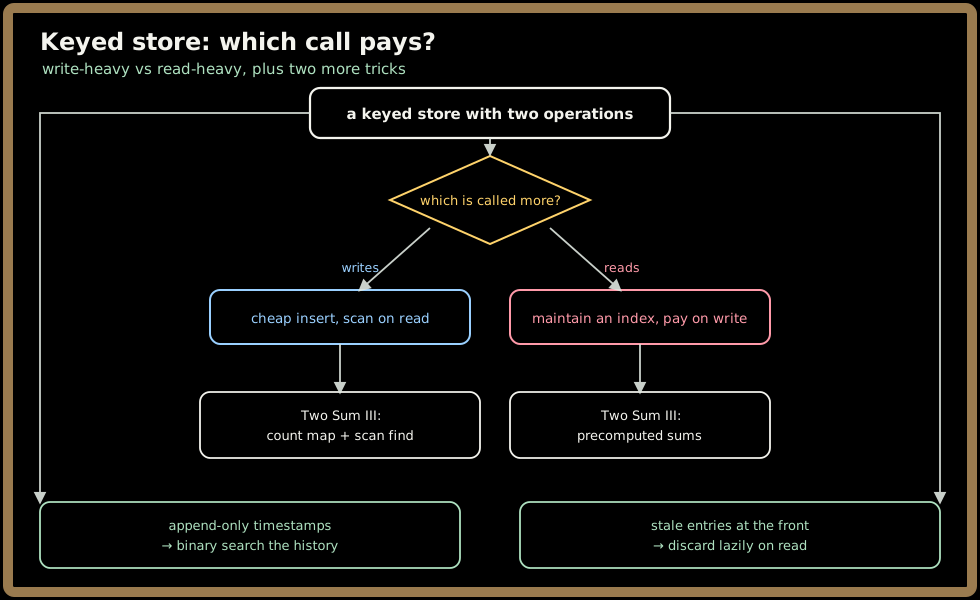
The one-line idea: decide which operation pays the cost, then pick the index that makes the other cheap — a sorted history for versioned reads, a count map for membership, or a queue with lazy eviction when staleness only matters at the front.
1. Versioned reads by binary search
store = defaultdict(list)                 # key -> [(timestamp, value), ...] ascending

def set(key, value, timestamp):
    store[key].append((timestamp, value))          # O(1) — timestamps increase

def get(key, timestamp):
    history = store[key]
    lo, hi = 0, len(history)
    while lo < hi:                                  # find the FIRST entry newer than t
        mid = (lo + hi) // 2
        if history[mid][0] <= timestamp:
            lo = mid + 1
        else:
            hi = mid
    return history[lo - 1][1] if lo else ""         # step back one; nothing before → ""
The search finds the first entry after the requested time and steps back one — the standard way to express "the largest value not exceeding the query" without a separate equality case. The if lo else "" handles a query older than every write.
2. Choosing where the cost lands
Two Sum III cannot make both add and find constant time, and the interview is about saying so:
| Design | add |
find |
Choose when |
|---|---|---|---|
| count map, scan keys on find | O(1) |
O(n) |
writes dominate |
| precompute all pairwise sums | O(n) |
O(1) |
reads dominate |
The count map version needs one subtlety: when the complement equals the value itself, that value must appear at least twice. Missing that reports find(4) as true for a store containing a single 2.
3. Lazy eviction
First Unique Number keeps a queue of candidates and a count map. Numbers whose count has risen above one are not removed when they stop being unique — they are simply skipped when they reach the front:
def show_first_unique():
    while queue and counts[queue[0]] > 1:
        queue.popleft()                    # discard stale entries, permanently
    return queue[0] if queue else -1
Each number is discarded at most once across the whole lifetime, so the amortised cost is O(1) even though a single call may pop several. Eager removal would require finding an arbitrary element in a queue, which is exactly what a queue cannot do.
4. A 30-second worked example (versioned get)
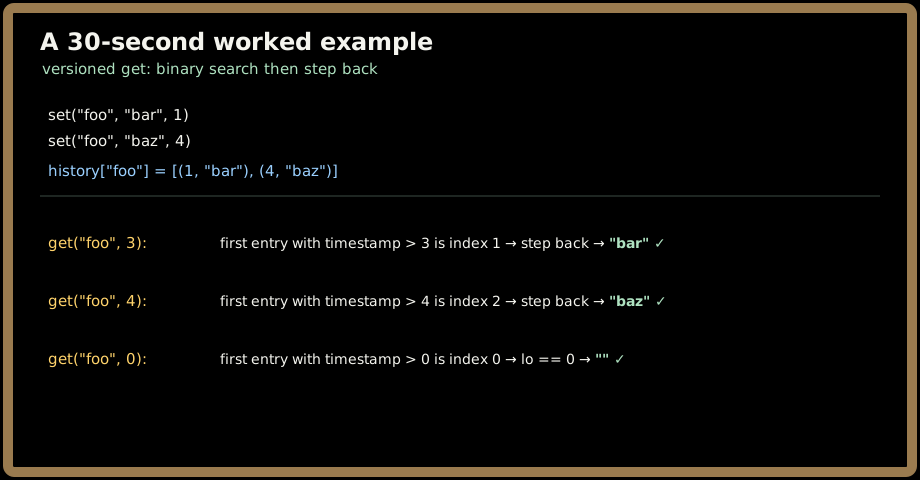
All three cases — between writes, exactly on a write, and before any write — fall out of the same search with no special handling.
5. Where you'll actually meet this
- Versioned storage. Point-in-time reads in databases, feature-flag history and configuration snapshots.
- Time-travel debugging. "What was this value at this moment?" over an append-only event log.
- Caching layers. Membership and frequency tracking where writes vastly outnumber reads, or the reverse.
- Stream deduplication. Tracking the first item still satisfying a property, with stale entries retired lazily.
- Audit trails. Append-only histories queried by timestamp.
6. Problems in this chapter
▶ Time Based Key-Value Store
set(key, value, timestamp) and get(key, timestamp) returning the newest value at or before that time. Append on write, binary search on read.
Pattern: per-key sorted history. Target: O(1) set, O(log n) get.
▶ Two Sum III - Data Structure Design
add(number) and find(target). Choose the count-map design or the precomputed-sums design, and justify it by the access pattern.
Pattern: deliberate cost placement. Target: O(1)/O(n) or O(n)/O(1).
▶ First Unique Number
Report the first still-unique number in a stream. A queue of candidates plus a count map, discarding stale front entries on read.
Pattern: lazy eviction. Target: O(1) amortised per operation.
7. Common pitfalls 🚫
- Sorting the history on every
set. The increasing-timestamp guarantee makes it unnecessary — but check that the problem actually gives it. - Returning the wrong side of the binary search. You want the last entry
<= t, which is "first entry> t, minus one". - Missing the empty result. A query before any write must return
"", not crash. - Forgetting the self-pair case in Two Sum III:
x + xrequires two copies ofx. - Claiming both operations are O(1). They cannot both be; the interviewer is waiting for you to notice.
- Eagerly removing from the queue. Queues have no cheap arbitrary removal — skip stale entries at the front instead.
- Re-counting on every read. Maintain the counts as numbers arrive.
8. Key takeaways
- Decide which operation pays, say so, and design around it.
- A guarantee in the statement is usually load-bearing — increasing timestamps are what make appends valid.
- "Last entry ≤ t" is "first entry > t, minus one". Learn one form of the search.
- Lazy eviction converts an impossible removal into an amortised skip.
- Keep a parallel index — the count map beside the queue is what makes staleness detectable.
- Handle the self-pair and the empty cases explicitly; both are routinely missed.
- Why interviewers like it: there is no single correct design, so the answer is your reasoning about the access pattern rather than the code.
Order: Time Based Key-Value Store → Two Sum III - Data Structure Design → First Unique Number.
First Unique Number
Core idea: Keep a
countmap (value → how many times it has arrived) and a queue of values in the order they first showed up.showFirstUniquepops stale heads off the front of the queue — anything whose count has climbed above 1 — until the front is a value withcount == 1, which is your answer; if the queue empties, return-1. The eviction is lazy: you never go hunting for a value that just became non-unique, you simply drop it from the front the next time it surfaces.
This problem is a clean lesson in lazy maintenance. The naive instinct on every showFirstUnique is to rescan the whole stream looking for the first value that appears exactly once — O(n) per query. The trick is to notice that "first unique" only ever moves forward: once a value stops being unique it can never become unique again. So a queue ordered by arrival, combined with a frequency map, lets you skip past the dead values once and amortize the cost away. Let's build it from the brute-force scan up to the queue-plus-count answer.
Problem, rephrased
An analytics pipeline watches error codes streaming in from production monitors, and the on-call dashboard highlights the earliest code that has fired exactly once so far — a one-off worth a human look, unlike codes that repeat by the hundreds. You're given an integer array nums — the codes that have already arrived, in order — and a stream that keeps growing: add(value) appends the next incoming code value.
Implement showFirstUnique(): return the value that arrived earliest among those currently seen exactly once, or -1 if every value so far has been seen at least twice (or nothing has arrived). The stream only grows and the dashboard polls constantly, so both operations must feel instant — amortized O(1) — with no rescan of the history on each query.
Strip the story away and this is First Unique Number (LeetCode 1429): design a structure initialized with nums that supports add(value) and showFirstUnique(), returning the first unique integer in the queue, or -1 if none exists.
| Operation | Input | Returns | Behavior |
|---|---|---|---|
add(value) |
an integer | nothing | append to the stream; updates how many times value has been seen |
showFirstUnique() |
— | the first value with count 1, in arrival order |
returns -1 if no unique value currently exists |
The showFirstUnique() row is the whole problem: it must respect arrival order (not just "any unique value") and stay fast even as values that were once unique get duplicated away.
Sign in to continue reading
The rest of this lesson is available with a free account. Signing in with Google or Microsoft is free.
Sign in to read the full lesson