Tree DP (Return One, Update Another)
What is this?
Imagine every employee in a company reporting one number to their manager — say, the length of the longest reporting chain beneath them. A manager with two reports cannot pass both numbers up; a chain through them can only continue in one direction. But the manager can notice that their two reports' chains, joined through them, form the longest chain in the whole company so far, and write that on the office whiteboard.
One number goes up. A different number goes on the whiteboard. That split is the entire technique.
💡 Fun fact: Path Sum III runs the machinery backwards. Instead of gathering information upward, it carries a running root-to-node sum downward and keeps a map of prefix sums seen along the current path — the identical trick as Subarray Sum Equals K, because a root-to-node path is an array. The one addition trees demand is that the map must be undone on the way back up, since a prefix belonging to one branch must not be visible to its sibling.
🔓 The 5 problems in this chapter are free. Sign in with Google or Microsoft to start solving.
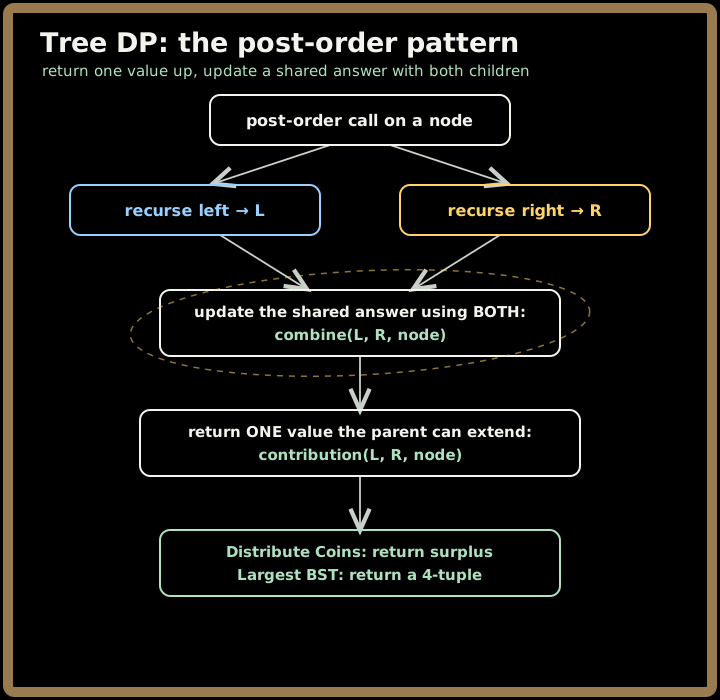
The one-line idea: a parent can only continue through one child, but the best answer often joins both at a node. So return the single best contribution upward, and update a shared answer with the combination — two different expressions, computed at the same moment.
1. The skeleton
answer = 0                            # the whiteboard

def dfs(node):
    global answer
    if not node:
        return 0                      # the identity for whatever you're combining
    L, R = dfs(node.left), dfs(node.right)
    answer = combine(answer, L, R, node)   # may span both children
    return contribution(L, R, node)        # what a parent can extend
Everything in this chapter is that shape with combine and contribution swapped out. The design work is choosing them — and choosing the return type, which is where richer problems get interesting:
| Problem | Returns | Shared answer |
|---|---|---|
| Distribute Coins | the subtree's coin surplus/deficit | total of abs(flow) across all edges |
| Second Minimum Node | the smallest value greater than the root's | the running best candidate |
| Smallest Subtree with All Deepest Nodes | (depth, covering node) |
the covering node at the deepest tie |
| Largest BST Subtree | (isBST, min, max, size) |
the largest valid size seen |
Largest BST Subtree is the clearest argument for rich return types. Checking BST-ness and measuring size separately means re-traversing every subtree, giving O(n²). Returning all four facts at once makes it one pass, because a parent can decide its own validity purely from what its children reported.
2. When the flow reverses
Not all information travels upward. Path Sum III passes a running sum down, along with a map of how many times each prefix sum has occurred on the current root-to-node path:
def dfs(node, running, counts):
    if not node: return 0
    running += node.val
    total = counts.get(running - target, 0)      # paths ending here
    counts[running] = counts.get(running, 0) + 1
    total += dfs(node.left, running, counts) + dfs(node.right, running, counts)
    counts[running] -= 1                          # UNDO before returning to the parent
    return total
That last line is the tree-specific part. Without it, a prefix recorded in the left branch stays visible while the right branch is explored, and paths are counted that do not exist.
3. A 30-second worked example (Distribute Coins)
Each node holds coins; every node must end with exactly one. A move transfers a coin along one edge.
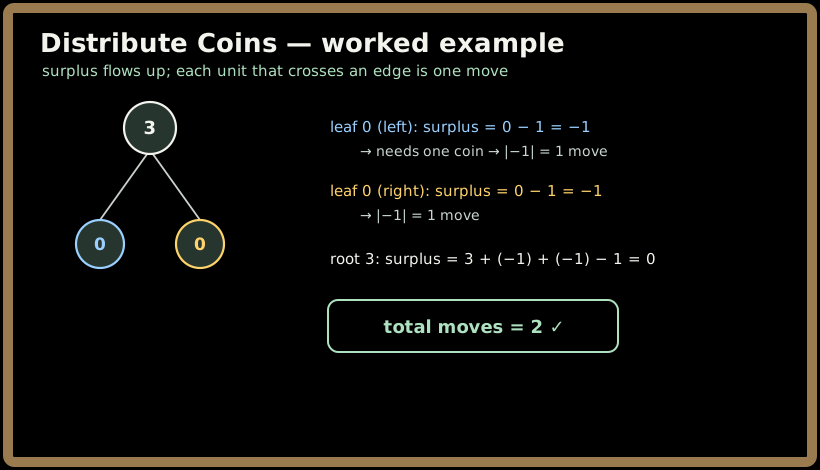
The insight is that the number of moves along an edge is the absolute surplus flowing through it — you never simulate a transfer. A subtree needing two coins forces two traversals of the edge above it, whatever order they happen in.
4. Where you'll actually meet this
- Resource balancing. Redistributing load across a hierarchy of nodes or teams, counting transfers, is Distribute Coins with different nouns.
- Compilers. Type checking and constant folding return a fact about each subtree while accumulating diagnostics globally — the same split.
- Financial rollups. Aggregating balances up an account hierarchy while flagging the largest compliant subtree.
- Network routing. Computing per-subtree demand to size links is the surplus calculation exactly.
- Query planners. Deciding whether a subtree of a plan satisfies a property (sorted, unique, indexable) needs the composite return type that Largest BST Subtree teaches.
5. Problems in this chapter
▶ Distribute Coins in Binary Tree
Move coins so every node holds exactly one, minimising moves. Return each subtree's surplus; accumulate abs(surplus) per edge.
Pattern: return a flow, accumulate its magnitude. Target: O(n) time, O(h) space.
▶ Path Sum III
Count downward paths summing to a target. Running prefix sum passed down, a count map, and the crucial undo on the way back up.
Pattern: prefix sums on a path + backtracking the map. Target: O(n) time, O(h) space.
▶ Second Minimum Node In a Binary Tree
In a tree where each node's value is the minimum of its children, find the second-smallest value overall. Return the smallest value strictly greater than the root's, pruning branches that cannot improve.
Pattern: targeted search with pruning. Target: O(n) time, O(h) space.
▶ Smallest Subtree with all the Deepest Nodes
Find the smallest subtree containing every deepest node. Return (depth, node); when both children report equal depth, the current node is the covering one.
Pattern: tuple return, tie means "here". Target: O(n) time, O(h) space.
▶ Largest BST Subtree
Find the largest subtree that is a valid BST. Return (isBST, min, max, size) so a parent decides its own validity from its children's reports alone.
Pattern: composite return type. Target: O(n) time, O(h) space — down from O(n²).
6. Common pitfalls 🚫
- Returning the combined value. The parent must receive a single extendable arm, not the bending answer. Returning
L + R + node.valbuilds invalid paths. - Forgetting to clamp negatives. In maximum-path problems a negative arm should contribute
0, not drag the total down. - Not undoing the prefix map in Path Sum III. The single most common bug in this chapter.
- Recomputing to validate. Checking BST-ness with a separate traversal per node is O(n²); return the facts instead.
- Wrong base case. The empty-subtree return must be the identity for your combination —
0for sums,-inffor maxima,(True, +inf, -inf, 0)for the BST tuple. - Mutable default arguments for the counts map — a classic Python trap that leaks state between calls.
- Ignoring recursion depth. A skewed tree of 10⁵ nodes exceeds the default limit; mention the iterative option.
7. Key takeaways
- Two expressions, one visit.
contributiongoes up,combinegoes on the whiteboard. - A parent extends one arm, so the return value must describe an arm, never a bend.
- Richer return types collapse passes. Tuples turn O(n²) verify-and-measure into one traversal.
- Information can flow downward too — prefix sums on a root-to-node path are just subarray sums.
- Undo what you recorded before returning to a parent, or siblings see each other's state.
- Get the base case right. It is the identity element of your combination, not always zero.
- Why interviewers love it: the code is fifteen lines and the design is everything. Choosing the return type correctly is the answer.
Order: Distribute Coins → Path Sum III → Second Minimum Node → Smallest Subtree with All Deepest Nodes → Largest BST Subtree.
The foundational members of this family — Maximum Path Sum, Diameter, Longest Univalue Path and Max Difference Node–Ancestor — are covered in Coding Interview 101. Work those first; the problems here assume the "return one, score with both" reflex is already automatic.
Largest BST Subtree
Core idea: Walk the tree bottom-up and have every node report a small "passport" about its subtree — is it a BST, how big is it, and what is its value range? A parent can then validate itself in O(1) by checking that both children passed and its own value slots cleanly between the left subtree's max and the right subtree's min.
Problem, rephrased
A maintenance job is auditing a search index after a bulk write was interrupted partway through: most of the structure is still correctly ordered, but some regions have drifted. You're given the root of a binary tree — an ordinary binary tree, with no ordering guaranteed — in which some subtrees may still happen to satisfy the Binary Search Tree rule.
Return the node count of the largest subtree that is a valid BST, so the job knows how much of the index it can keep and how much it must rebuild. A subtree here is a node plus every descendant beneath it — you can't drop a node's corrupted entries and keep the rest of its region. A valid BST means that for every node in it, all values in its left subtree are strictly smaller, all values in its right subtree are strictly larger, and both sides are themselves BSTs.
Strip the story away and this is the classic Largest BST Subtree: given the root of a binary tree, find the largest subtree that is also a valid binary search tree and return the number of nodes it contains.
Input / Output
Input (level-order, None = missing child) |
Output | Why |
|---|---|---|
[10, 5, 15, 1, 8, None, 7] |
3 |
The subtree {5, 1, 8} is a valid BST of size 3; the full tree is not (7 sits in 15's right but 7 < 10). |
[5, 3, 8, 1, 4, 7, 9] |
7 |
The entire tree is already a BST. |
[] |
0 |
Empty tree, nothing to count. |
[12, 20, 30, None, None, 25, 40] |
3 |
Root 12 is broken (20 on its left), but the subtree {30, 25, 40} is a clean BST. |
Sign in to continue reading
The rest of this lesson is available with a free account. Signing in with Google or Microsoft is free.
Sign in to read the full lesson