Permutations and Combinations
What is this?
Enumerating arrangements is the easiest kind of backtracking to write and the easiest to get subtly wrong. The search itself is mechanical — pick something, recurse, put it back. The difficulty is duplicates: when the input contains repeated values, a naive enumeration emits the same arrangement several times, and filtering them afterwards with a set is both slower and a sign that you did not understand where they came from.
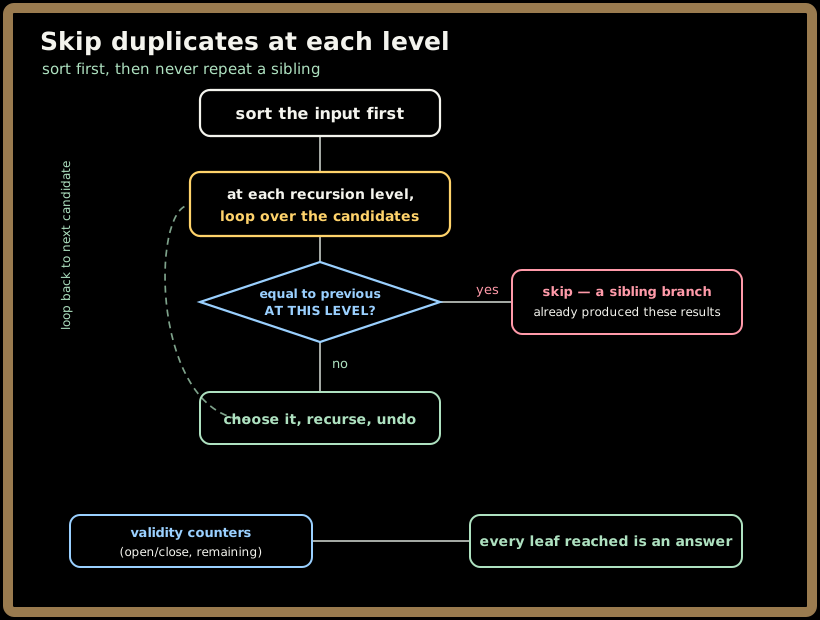
The fix is a single line, and knowing exactly why it works is what the interview is testing.
💡 Fun fact: the duplicate-skip condition is
i > start and nums[i] == nums[i-1]— and thei > starthalf is what makes it correct. Equal values must be skipped when they are siblings in the recursion tree, because a sibling branch has already generated everything that branch would. They must not be skipped when they are ancestors, because[1, 1]is a perfectly legitimate arrangement of two equal values. One comparison separates the two cases, and getting it wrong drops valid answers rather than duplicates.
🔓 The 6 problems in this chapter are free. Sign in with Google or Microsoft to start solving.
The one-line idea: sort first, then at every level skip a candidate equal to the one just tried at that same level. For validity-constrained enumeration, carry counters instead of generating-then-filtering, so the search only ever walks toward legal answers.
1. Subsets and combinations
def subsets(nums):
    nums.sort()
    result, path = [], []

    def backtrack(start):
        result.append(path[:])              # every node is an answer, not just leaves
        for i in range(start, len(nums)):
            if i > start and nums[i] == nums[i-1]:
                continue                    # sibling duplicate — skip
            path.append(nums[i])
            backtrack(i + 1)
            path.pop()                      # undo

    backtrack(0)
    return result
Two things to notice. result.append(path[:]) happens at every node, because every prefix is itself a valid subset — unlike permutations, where only complete leaves count. And path[:] copies; appending path itself stores a reference that later mutations will corrupt, which is one of the most common silent bugs in this family.
2. Permutations with duplicates
Permutations differ because every element is used exactly once, so you need a used array rather than a start index:
for i in range(len(nums)):
    if used[i]:
        continue
    if i > 0 and nums[i] == nums[i-1] and not used[i-1]:
        continue                            # the equal predecessor is unused → sibling duplicate
    used[i] = True
    path.append(nums[i])
    backtrack()
    path.pop(); used[i] = False
not used[i-1] is the permutation form of the same idea: if the identical previous value has not been used at this point, choosing this one now duplicates a branch that already ran.
3. Prune, do not filter
Generate Parentheses shows the alternative to duplicate-skipping — constrain the search so invalid states never appear at all:
def gen(path, open_used, close_used):
    if len(path) == 2 * n:
        result.append(''.join(path)); return
    if open_used < n:                       # can always open while any remain
        gen(path + ['('], open_used + 1, close_used)
    if close_used < open_used:              # only close what has been opened
        gen(path + [')'], open_used, close_used + 1)
Every leaf reached is a valid string. Nothing is generated and discarded, which is why this is O(Catalan(n)) rather than O(2^(2n)).
4. A 30-second worked example (why i > start matters)
nums = [1, 1, 2], generating subsets:
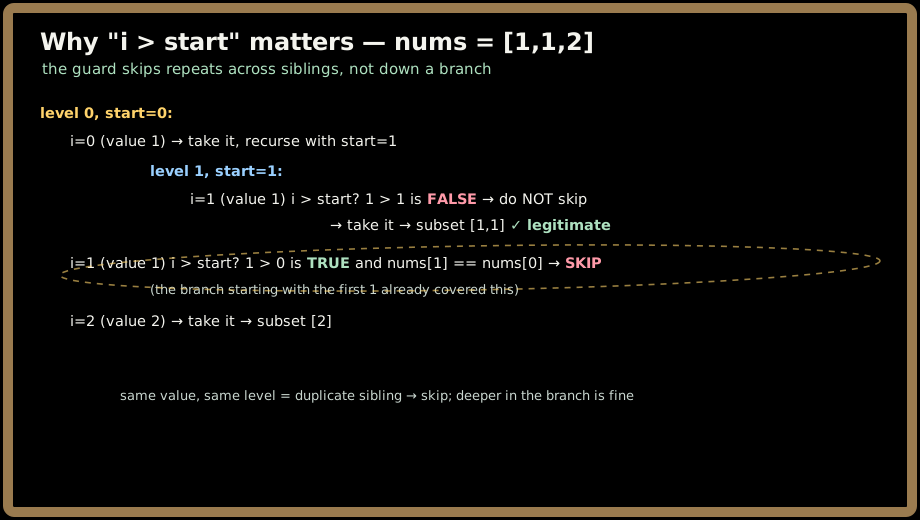
The same value is skipped in one place and kept in the other, and i > start is the only thing distinguishing them. Skipping both would lose [1,1]; skipping neither would emit [1] twice.
5. Where you'll actually meet this
- Test-case generation. Enumerating distinct input combinations, where duplicates waste time without adding coverage.
- Configuration search. Trying every valid combination of feature flags or parameters.
- Security tooling. Enumerating candidate arrangements of a key space under constraints.
- Predictive text. Letter Combinations is the original T9 keypad expansion.
- Scheduling and seating. Distinct assignments where interchangeable people or slots must not multiply the result set.
6. Problems in this chapter
▶ Generate Parentheses
All valid combinations of n bracket pairs. Two counters constrain the search so every leaf is valid.
Pattern: counter-pruned generation. Target: O(Catalan(n)) results, O(n) recursion depth.
▶ Subsets
Every subset of a collection. Record at every node, not only at leaves.
Pattern: start-index backtracking. Target: O(2ⁿ · n) time.
▶ Permutations II
All distinct permutations of a collection containing duplicates. A used array plus the not used[i-1] skip.
Pattern: permutation backtracking with sibling-duplicate skipping. Target: O(n! · n) worst case, fewer with duplicates.
▶ Palindrome Permutation II
All palindromes formable by rearranging a string. Check feasibility by character parity first, then permute half the string and mirror it.
Pattern: feasibility check + half-permutation. Target: O((n/2)! · n).
▶ Letter Combinations of a Phone Number
Every string from a digit sequence on a phone keypad. Straight product enumeration, one digit per recursion level.
Pattern: cartesian-product backtracking. Target: O(4ⁿ · n).
7. Common pitfalls 🚫
- Appending
pathinstead ofpath[:]. Storing a reference means later mutations silently corrupt every recorded answer. - Deduplicating with a set at the end. It works, hides the real insight, and costs both time and memory.
- Skipping duplicates without the
i > startguard. Legitimate arrangements of equal values disappear. - Forgetting to sort. The duplicate skip relies on equal values being adjacent.
- Recording only at leaves for subsets. Every node is an answer there; only permutations require completeness.
- Permuting the whole string in Palindrome Permutation II. Permute half and mirror it.
- Skipping the parity check. A string with two odd-count characters has no palindrome at all, and testing that first avoids an entire pointless search.
- Binary Watch — every time displayable with exactly
nLEDs lit. Enumeration over a tiny fixed space, and the neat version skips backtracking entirely by counting set bits over all 12 x 60 times.
8. Key takeaways
- Sort, then skip sibling duplicates. One line replaces post-filtering entirely.
i > start(ornot used[i-1]) is the whole subtlety — it separates siblings from ancestors.- Copy the path when recording. References are the classic silent corruption.
- Subsets record at every node; permutations only at leaves.
- Prune with counters rather than filtering when validity can be maintained incrementally.
- Check feasibility before searching. A parity test can rule out the whole search space instantly.
- Why interviewers like it: everyone can enumerate. Producing distinct results without a deduplicating set, and explaining why the skip is correct, is the differentiator.
Order: Generate Parentheses → Subsets → Permutations II → Palindrome Permutation II → Letter Combinations of a Phone Number → Binary Watch.
Palindrome Permutation II
Core idea: A palindrome is fully determined by its first half plus an optional center character — the second half is just the first half reversed. So don't permute the whole string and filter for palindromes (most of that work is wasted). Instead: count the characters, check feasibility (at most one character may have an odd count, otherwise no palindrome exists), set that single odd character aside as the center, and build the half multiset by taking each character
count // 2times. Generate every unique permutation of that half (Permutations II–style dedup so repeated characters don't produce duplicate palindromes); for each halfh, emith + center + reverse(h).
Problem, rephrased
A brand team wants "mirror codes" for a scratch-card campaign — promo codes that read the same forwards and backwards, each built from the exact set of characters allotted to this print run. You're given a string s — the multiset of characters every code must use, each character used exactly as many times as it appears.
Return all palindromic permutations of s, without duplicates, in any order — every distinct code goes to print, so the same string must never appear twice. If no arrangement of s reads the same both ways, return an empty list.
Strip the story away and this is the classic Palindrome Permutation II problem: given a string s, return all the palindromic permutations of it (without duplicates), or [] if s has no palindromic permutation.
A worked input/output
| s | Output | Why |
|---|---|---|
"aabb" |
["abba","baab"] |
Half multiset is {a, b}; its two unique permutations ab, ba mirror into abba, baab. No center (all counts even). |
"abc" |
[] |
Three characters each with an odd count (1) — more than one odd, so no palindrome is possible. |
"aabbc" |
["abcba","bacab"] |
c has odd count → it's the center; half is {a, b} → abcba, bacab. |
"a" |
["a"] |
Single character is its own palindrome; empty half, center a. |
Notice the output depends only on the character multiset, never on the input ordering — "aabb" and "bbaa" produce the same answer.
Sign in to continue reading
The rest of this lesson is available with a free account. Signing in with Google or Microsoft is free.
Sign in to read the full lesson